

Build The Jealous Free Zone 🚫
Part 3 in a series of 4 articles based upon the lessons from Coach K 🇺🇸 🏀 and several field hockey 🏑 experts sharing insights about fun, talent, culture and legacy.


Tactics get you results for a season. Culture gets you results for a generation… and when it matters.
That’s the thesis. And if you’ve been coaching long enough, you know it’s true in your bones. Even if the day-to-day demands of training sessions, selection headaches and match preparation don’t always give you the time to act on it. You know that the team with the better pressing structure doesn’t always win. You know that the team that plays for each other usually does.
In this third article in our series drawing on the wisdom of basketball legend Coach K and the field hockey experts in The Hockey Site’s catalogue, we’re going to dig into the very important, often neglected, and most misunderstood word in coaching: culture. What it actually means. How you build it deliberately rather than accidentally. And, crucially, how you know when you’ve got it.
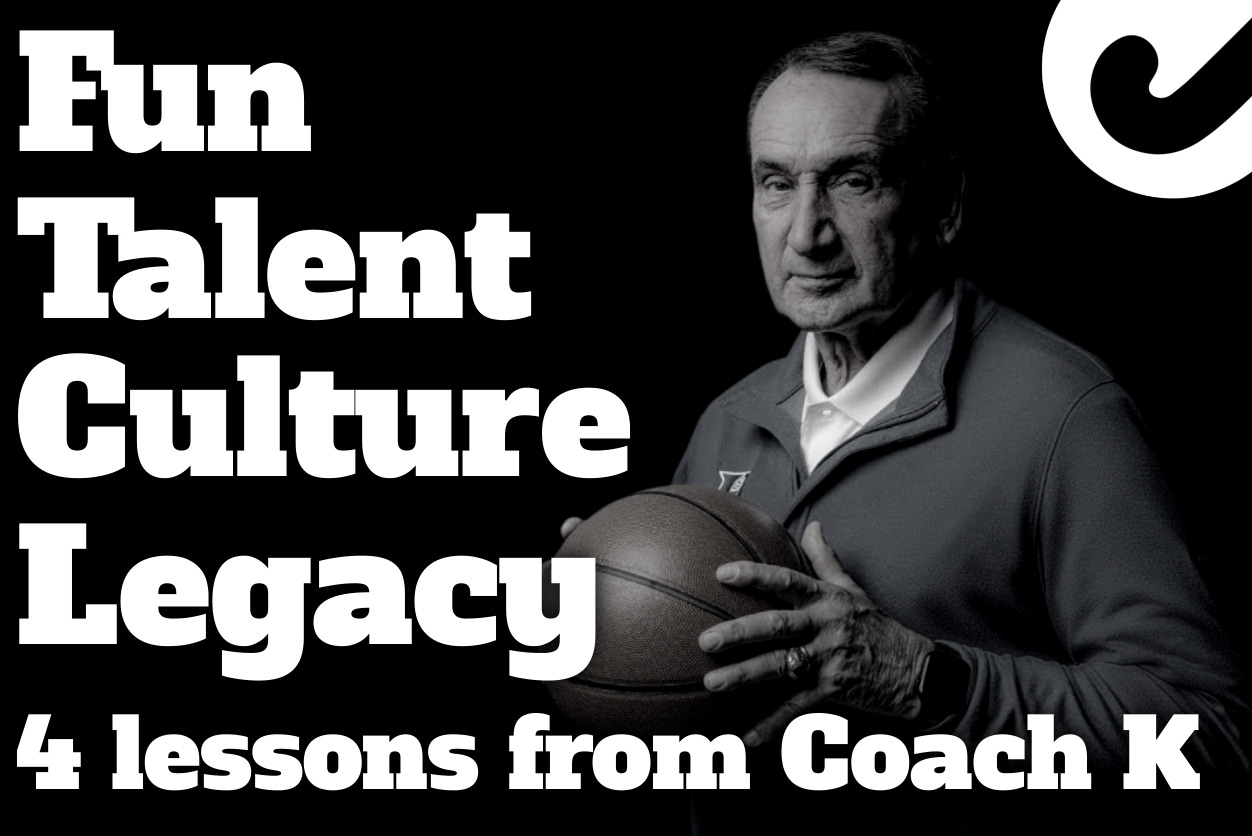
We’ll look at where culture starts (values — and not just words on a wall), how it becomes operational (standards — the lived, daily expression of those values), what it looks like when it’s working (the jealous-free zone), and what threatens it and how to respond. Along the way we’ll draw on Coach K’s values framework and championship stories, on Adam Commens’ remarkable perspective from inside two of the greatest team cultures in hockey history as well as his earlier insights on Values Based Coaching, and on Theo ten Hagen’s practical work on team dynamics.
Values: The Foundation Nobody Fully Builds
Coach K opens his lesson on core values with a simple image: a fist. Five fingers — communication, trust, care, collective responsibility, and pride. Each meaningful on their own, but only truly powerful when they come together. “The five values working together create a powerful unified team, like fingers forming a fist.” The framework is simple to understand, he says, but not necessarily simple to execute.
That gap between simple and easy is exactly where most team cultures either take root or wither. Because the values conversation in most sports environments looks like this: a coach writes three or four words on a whiteboard at the start of pre-season, asks players if they agree, everyone nods, and by match three of the season, nobody mentions them again. Coach K is blunt about this:
“Don’t just give values to your group. Involve them in discussing and defining what the values mean. Team members must own the values. They’re not just words but ways of life.”
Adam Commens makes the same point with equal force. As Belgium’s High Performance Director, he has spent years building and sustaining values-driven cultures at the highest level. First as a player and coach with Australia’s Kookaburras, then as a key architect of the Red Lions’ Olympic and World Cup gold. His verdict on values that live only as posters: “A lot of companies or federations or sporting clubs, they have values. But quite often, you see them just as words on the wall, and there’s not much underneath that. With every value, you try to go into depth about what does this mean, what are the behaviors that would demonstrate that particular value on the pitch, how would that work on or off the pitch.”
This is the shift that separates high-performance culture from high-performance theatre. Belgium’s youth national programme, for example, uses the acronym TYPE: Team, You, Passion, Excellence. But what makes it work isn’t the acronym. It’s the painstaking work of unpacking what each word means in practice, in training, in a tough match, in how you treat a teammate who is struggling. Commens describes the process: players and staff work together to name the observable behaviours beneath each value.
What does “excellence” look like in the first five minutes of training? What does “passion” look like when you’ve just conceded the lead with ten minutes to go? Those conversations and what you do with these are the culture. The words on the wall are just the shorthand.
For your own programme, the practical takeaway is this: don’t skip the depth. However you choose your values, whether you generate them collaboratively, propose them to the group, or inherit them from your club’s history, spend significant time defining what they look like in action. Make them behavioural, not aspirational. Excellence” is too abstract. “Excellence means your first touch is at international speed, every repetition” is something a player can actually live.
From Values to Standards: How You Actually Live Them
Coach K draws a distinction that’s worth sitting with. Values, he says, are the guiding principles that drive a team. Standards are the ways you live those values — “how you do things all the time.” And then he says something that changes the frame entirely:
“You never own a rule. You obey or disobey it. But a standard is yours.”
That ownership distinction matters enormously. When the USA Basketball team gathered for the 2008 Olympics — arguably the most talented team ever assembled, with Kobe Bryant, LeBron James, and Chris Paul in the same squad — Coach K didn’t walk in and hand them a rulebook. He met individually with key players beforehand and then asked the group to build their own standards together. LeBron proposed “no excuses.“ Others added looking each other in the eye and telling the truth, never being late, and never having a bad practice. Fifteen standards in total. All of them player-generated, all of them owned.
“Not asking players to play for the United States, but to be United States basketball. To own it.” That shift from external obligation to internal identity is the engine of culture. And it didn’t just apply to practices and games. When the coaching staff placed Olympic uniforms on each player’s bed, Kobe Bryant reportedly cried. That’s what ownership feels like.
Commens describes exactly the same mechanism in his values-based coaching approach. The moment he knew values were genuinely embedded wasn’t when the coaching staff referenced them. It was when the players did. “They’re only gonna do that if you as a coach do it. I remember when I first started using this, I was working with a psychologist or a mentor that watched the way that I was presenting, and he said to me: when you call the team in, I want you to talk about one of the values.” The behavioural prompt from the coach creates the habit; the habit becomes the culture; and eventually the culture polices itself. When you hear your players using the language of values with each other — not to you — you know it’s real.
A practical tool Commens recommends for coaches is what he calls a balance check between “results” focus and “values” focus in your communication. Most coaches, if they’re honest, spend 90% of their communication time on the results axis — what to do tactically, what went wrong, what needs to change. Values barely feature. The invitation is to audit that balance, and to deliberately build values language into every session, every team talk, every debrief. Not as a replacement for tactical thinking, but as its constant companion.
The No-Jerk Zone
Shane Battier, four-year starter at Duke and one of the most influential culture carriers Coach K ever coached, describes the environment at Duke in one pithy phrase: “It was a no-jerk zone.” Negativity and ego didn’t last, he explains, because they “sucked energy from our group.” This wasn’t a formal policy. There was no clause in the player handbook. It was simply what the culture did not tolerate and it was enforced not primarily by the coach, but by the group itself.
Every team has its version of this test. The question is whether the culture is strong enough to self-police, or whether it requires constant intervention from the coach. Coach K is clear: culture requires active maintenance. Bad behaviour or cultural problems must be addressed immediately. “Bad can grow faster than good.” Don’t let it fester.
Commens speaks to this with particular clarity when it comes to players who are talented but less committed. It’s a situation every coach encounters, and the temptation is always to default to the more committed player. The one who ticks every box behaviourally even if their ceiling is lower. Commens pushes back on this instinct: “I wouldn’t suggest that you take the more committed player. I would suggest that you take the talented player and try to create an environment where they’re challenged, to bring that creativity and talent to the team.” The answer isn’t to lower your cultural standards. It’s to make the environment compelling enough that talent wants to commit. That’s a harder ask of the coach, but it’s the right one.
Theo ten Hagen’s work on team dynamics adds a crucial layer here. Using personality profiling tools like Lumina Spark, ten Hagen’s approach is to create “one language” for behaviour that allows squads to discuss differences — including difficult ones — productively. In his experience, diverse teams are stronger teams, but only if the diversity is acknowledged and worked with rather than smoothed over. The no-jerk zone is not a monoculture. It is an environment where different people can coexist, challenge each other, and bring different qualities. Provided everyone is playing by the same basic rules.
What Championship Culture Looks Like: Common Themes at the Top
Commens has a rare vantage point. He was inside two of the most successful team cultures in the history of field hockey: the 2004 Australian Kookaburras and the 2021 Belgian Red Lions and has spent years analysing what they shared. The results are less tactical than you might expect.
The first common theme is commitment and proactivity. Both teams had players who arrived well before the start of official training, not because they were told to, but because they wanted to. The Kookaburras had a phrase for it: “If you’re half an hour early, you’re late.” Not because of a rule, but because the culture made arriving early the obvious thing to do. When you trained alongside Jamie Dwyer every day, you understood very quickly what world’s best looked like and you adapted accordingly. The Red Lions had the same pull: their training ground became a second home.
The second common theme is something Commens calls unique quality or what he sometimes refers to as a player’s “superpower.” At elite level, he argues, hard work is simply the entry requirement. It is not a differentiator. “At the top level, everybody works hard. Hard work is a given. But really what makes a difference is the quality of everything that you do.”
Every player who stays in a high-performance squad needs to bring something specific that the team cannot do without. Identifying that quality and designing an environment that develops and celebrates it, is one of the coach’s most important jobs.
The third common theme is what Commens describes as mateship and connection. Not team-building exercises and trust falls. Real, durable, off-pitch relationships. “There was that culture of caring. And that also existed with the Red Lions. Everybody had each other’s back. Even when you look at the Red Lions, when they go on holidays, usually they go on holidays with each other.” This is not something you can manufacture. But you can create the conditions for it. And Commens is equally clear about what drives it: spending time learning why each individual is there. Not their tactical role. Their actual motivation.
“Both teams that won gold spent an enormous amount of time learning the why behind each individual. You form a bond, you form a connection and then you also get to understand what are the types of things that that particular player wants to hear in the key moments.”
This is Commens’ central claim, and it’s a bold one:
“Connection is more important than tactics.”
All teams at the elite level are technical and tactical experts, he says. The differentiator is the depth of understanding between coach and player, and between player and player. If you nail that, you’ve gone a long way to becoming a really high-level coach.
Protecting the Culture: When Adversity Hits
The most revealing test of a culture is not what happens when things are going well. It’s what happens when they aren’t.
Coach K tells the story of the 2001 Duke championship run, the one that nearly didn’t happen. Midway through the season, their best player Carlos Boozer broke his foot. On senior night. Duke lost the game. The next morning, Coach K called practice, and the team came in mentally absent, their minds clearly elsewhere. He stopped it. “Come back when you’re ready to practice. Come back when you’re ready to be Duke.”
The senior captains took the team back to the locker room. Shane Battier wept. He reminded his teammates that this was the end for the seniors, there was no next year. When they returned to practice, Coach K presented a new plan and made a promise: if they believed in it, they would win the national championship. The team didn’t mourn what they’d lost. They adapted to what they had.
What followed — the three-point blitz against Carolina, the run to the Final Four, the championship against Arizona — is well documented. But the key moment, the one that mattered most, came in the championship game itself. Mike Dunleavy had been struggling badly. His shots weren’t going in. And yet, when the ball needed to move, it moved all the way around and back to Dunleavy in the corner. He hit it. Then another. Then a third. Coach K called it proof of the “jealous-free zone” : teammates who took extreme, genuine delight in each other’s success, even when their own form was poor.
That is what culture looks like under pressure. Not a system. Not a tactical adjustment. A group of people who genuinely want each other to do well, who will move the ball to the corner even when they might want it themselves.
Commens describes the same quality in his work on values under pressure. It’s the hardest moment to maintain culture, he says. When there’s scoreboard pressure, when you haven’t beaten a team in months, when everything is on the line. “The most difficult moment is when your players are under pressure. At that moment, it’s the most difficult time for them to keep the values at top of mind.” His response is to redefine success before those moments arrive. Not “win or lose,” but “did we live our values?” When players can walk off the pitch having demonstrated their behaviours fully, regardless of the result, that is genuinely a success. And paradoxically, that reframing is what gives teams their best chance of winning. Freed from the fear of the outcome, they play with exactly the kind of freedom that makes champions.
Build something worth passing on
The invitation for every hockey coach, at whatever level, is this: build something worth passing on. Not a system of play, though that matters. Not a set of results, though those matter too. A set of values, behaviours, and standards that players carry with them when they leave your environment and that make the next environment they enter fractionally better because of it.
Coach K has a phrase for the cultural ask he makes of his players: “Unpack your bags.” Don’t treat this like a rental. Don’t play with one eye on the exit. Be fully present, because this environment — right now, this group of people — is worth the investment.
That’s the jealous-free zone. And it’s yours to build.
In summary: Culture doesn’t happen by accident. It starts with values. Not words on a wall, but behaviours you can see, recognise, and reinforce every single day. It becomes operational through standards that players own rather than rules they obey. It reveals itself most clearly in the moments of adversity and competition, when teammates move the ball to the corner for someone else, when they define success as living their principles rather than just winning the game. And it perpetuates itself, long after you’re gone, when the players you shaped start shaping others. Build the jealous-free zone. Build something worth passing on.
Some of the sources used:
Keep your eye out for the other articles on fun, talent & our next one on legacy 😉