

“Choose Easy” First: A Smarter Way to Train GRIT in U12
Training & Coaching GRIT in your U12 field hockey team


“Enthusiasm is common. Endurance is rare.” — Prof. Angela Duckworth
👉 (Passion + Perseverance) x Long Term Goals = GRIT
In U12 hockey, coaches rarely lose players because they cannot dribble or hit hard. They lose players because the game starts to feel like a judgement. A mistake becomes something to hide. A tough opponent becomes a reason to switch off. A louder teammate becomes a reason to stop asking for the ball. In other words, the constraint is psychological, not technical.
According to Angela Duckworth, professor in psychology and a MacArthur Genius Grant winner for her research, GRIT is not a synonym for being “tough.” It is a combination of passion and perseverance toward a goal that takes a long time to achieve. [1]
That matters in U12 field hockey teams because a lot of what we call “quitting” is not actually a lack of character. It is often a lack of interest (the passion side), a lack of skills to recover (the perseverance side), or a situation that makes trying feel too costly. Duckworth also distinguishes grit from self-control or discipline. Self-control is the everyday ability to resist impulses and do the small things, like going to bed on time or doing the boring rep. Grit is the longer arc of staying committed to something that matters to you.[1]
So for U12s, grit is not about demanding adult-like resilience. It is about helping players find reasons to care, teaching them what to do next when it goes wrong, and designing an environment where they keep choosing to try again.

Duckworth makes a crucial point for coaches here: before you ask children to “work hard,” you have to help them choose easy — the version of the task that feels doable and worth engaging with. In her words:
“Choose the easiest one. Choose the one that you want to think about. Choose the one that you’re good at. Yeah, work hard, but first choose easy!”
When you start there, you create early “I can do this” moments, which keeps motivation alive long enough for perseverance to form. In U12 hockey terms, that means designing first reps and first games where success is frequent (not just scoring, but winning the ball back, getting a clean receive, offering again after a mistake), and then gradually turning the dial up. Grit, for children, is built step-by-step — not by throwing them into the deep end and calling it resilience.
Field hockey adds a particular twist. The sport has lots of micro-failures. First touches bounce, tackles miss by a stick length, and decisions have to be made under speed. If the coaching environment makes those moments feel costly, players protect themselves by playing safe, hiding, or disengaging. If the environment makes those moments feel informative, players stay brave, and bravery becomes the visible face of grit.
TLDR: how to train grit in U12 hockey without turning it into a lecture
You build grit by shaping the learning environment so that effort is normal, mistakes are useful, and the team identity rewards trying again. You then train “impact behaviours” in short, repeatable scenarios, so players experience themselves recovering from setbacks. Finally, you coach the coach: your feedback, your tone, and your session design decide whether children connect effort to improvement.
This article draws on the following from The Hockey Site:
What “grit” looks like on a hockey pitch at U12
If we keep grit abstract, it becomes motivational wallpaper. In U12 hockey, grit is a handful of behaviours you can see. A player who gets tackled and immediately offers again. A defender who concedes a free hit and then resets body shape instead of arguing. A goalkeeper who lets in a soft goal and still communicates. A team that is losing and keeps attempting the same brave solutions, but with slightly better choices each time.
This is why I like to treat grit as a training outcome, not a personality trait. It is something the group does, not something a child either “has” or “doesn’t.”
Henk Verschuur’s point about the cognitive process of coaching matters here. In pressure moments, players can only take in so much information, and the coach’s tone and timing determine what actually lands. The same is true in children’s hockey, just with a lower threshold. If a coach overloads the moment with criticism, the child learns that pressure equals threat. If a coach reduces the moment to one clear cue and a calm reset, the child learns that pressure is manageable.
Grit is built through interest, commitment, and situations that help
“We need to be gritty about getting our kids grit.” — Angela Duckworth.[2]
If you want a practical coaching translation of Duckworth for youth, it is this. Grit grows when young people are allowed to sample widely at first, find what genuinely sparks their interest, and then, over time, commit more deeply to the right hard thing.[2][1]
This is important in U12 hockey because the aim is not to make every child “specialise” in gritty suffering. The aim is to help them build a healthy relationship with hard things. Duckworth’s “hard thing rule” for kids captures this nicely:
Children choose a hard thing themselves, they do not quit halfway through a season, but they are allowed to quit at the end if it is not the right fit, and try a different hard thing instead.[2]
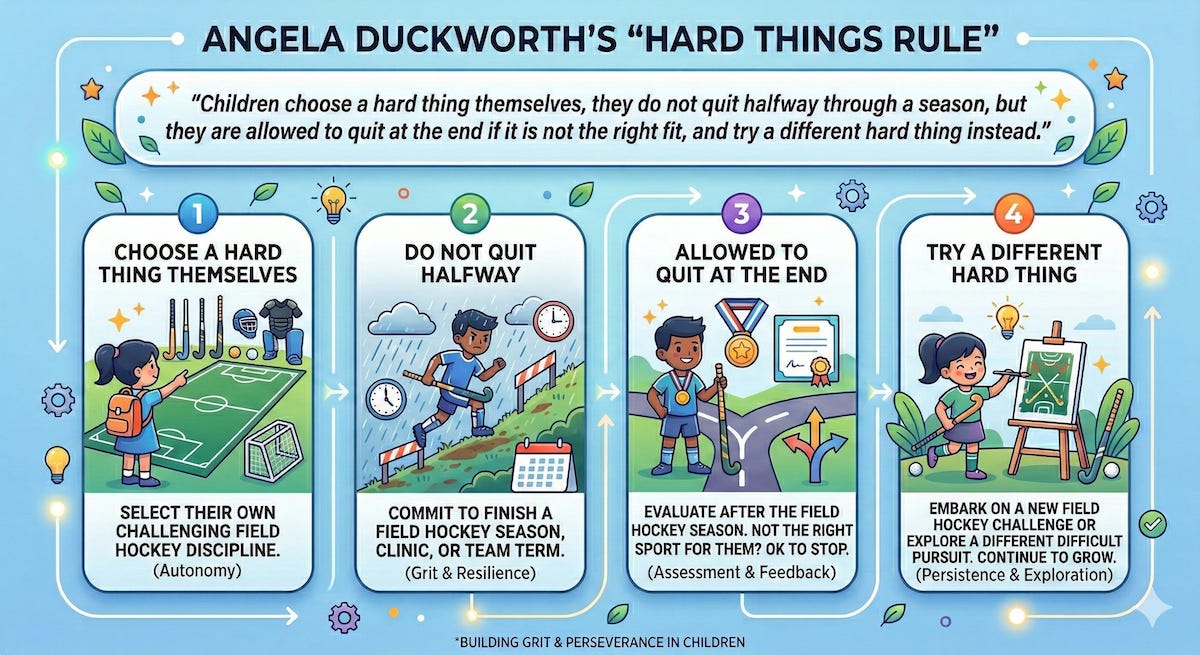
That framing keeps grit from turning into stubbornness. It also protects joy. The coach can hold standards for effort and commitment inside the season while still being curious about whether the child is in the right place long-term.
A second youth insight from Duckworth is that grit is often forged in a crucible of challenge plus support. Challenge on its own can break confidence. Support on its own can produce comfort without growth. The combination is where children learn, “This is hard, and I can handle it.”[1]
U12-specific reality: motivation is fragile, attention is narrow, and meaning is social
At U12, players do not persist because a coach explains the value of long-term goals. They persist because the next repetition feels safe enough to attempt and meaningful enough to care. In practice that means three things.
