

Coach the Chaos: Transition Rules For Youth Hockey
3 solutions for coaching transitions in youth field hockey + some suggestions for training sessions


“Transitions are an open situation. It is happening all of a sudden, and it’s always different. You can never find exactly the same transition twice.” — Andreu Enrich
Why youth transitions feel chaotic (even for good teams)
If you coach youth hockey, you already know this moment. You win the ball, and for half a second it feels like you’ve got them. Then the first touch is heavy, a rushed pass gets picked off, and suddenly your team is defending a counter with players facing the wrong way.
Or the other side of the same coin.
You lose the ball, and two or three players feel the turnover… but nobody acts together. One presses. Another jogs. A third goes hunting for a stick tackle they are not going to win. And the opponent gets exactly what every counter-attacking team wants: time to lift their head and play forward.
That is why the “3 seconds after you win or lose it” matters so much.
It is the only phase of the game where:
Everyone is out of shape.
Decisions have to be made without certainty.
One touch can flip the whole pitch.
And here’s the honest bit. Most of us coach the stable stuff more, because it’s easier to plan.
As Enrich says, transitions are “open” by definition. So the goal is not to control them like a set piece.
The goal is to give your players a default.
Not a play.
Not a pattern.
A default decision process and a shared set of behaviours that makes chaos predictable.
TL;DR
If you want youth transitions to look simple, you need three things: (1) a clear “first 3 seconds” decision tree for the ball winner (forward if it is clean, otherwise carry, otherwise link, otherwise protect and reset), (2) a team rule for the first 3 seconds after ball loss that assigns roles (Hunter pressures the ball, Blockers kill the middle and first forward pass, Home players sprint back to protect centre), and (3) rest-defence habits in your attacking shape so you are already ready for the turnover (protect centre, cover and delay, and avoid the double turnover by choosing the right first pass after you regain). Train this in games that create lots of turnovers, and your players stop “thinking about transitions” and start living them.
Some of the sources used:
Managing transitions

Managing transitions was the topic of the masterclass by Andreu Enrich and it resulted in a very interesting presentation and conversation.
Counter Attack

A new masterclass by Fede Tanuscio was hosted by us on November 22, 2024. Topic of the day: the different ways to perform a counter attack.
Rest Defence in Field Hockey: Key Principles, Transitions & Training

One to remember from this session on rest defense: it’s the power and necessity of defending intentions, not just positions, during transitions. This fundamental concept, as highlighted in detail during the masterclass, doesn’t just tweak your team’s defensive solidity—it can transform the whole risk profile of your play, significantly reducing dangerous counter-attacks and double turnovers. For seasoned coaches, this might sound straightforward, but it’s often overlooked as we get caught up in the structures, patterns, and drills that dominate our planning.
Defensive transitions

If there’s one core lesson that stands out from this workshop on defensive transitions, it’s the importance of designing training sessions with deliberate principles that directly trigger the game actions you want your players to master. In modern field hockey, transition moments define outcomes. High-level games are littered with rapid turnovers, and t…
But you’ll find many more useful videos on The Hockey Site ;)
Quick clarity: what exactly is “the 3-second window”?
Coaches mean different things when they say “transitions,” so here is the definition I’m using.
Offensive transition (win it): starts the moment you regain possession and lasts until you either:
progress with control (carry or pass forward), or
stabilise with a link/reset (safe sideways/backwards), and the team is back in a recognisable attacking shape.
Defensive transition (lose it): starts the moment you lose it and lasts until you either:
have ball pressure and the centre is protected, or
you have dropped and rebuilt your defensive organisation (counter-defence).
So yes, it is “3 seconds”… but it is really about the first action.
One important note (so you don’t overcoach this)
These are principles, not patterns.
The picture will change.
Your decision order stays.
That is how you keep creativity alive while still having structure.
The “3 seconds” solutions (what to coach)
1) When you win it: give the ball winner a decision tree (not a speech)
If you want U12–U18 players to be calm in transition, you need to reduce the number of decisions, not add more.
Enrich describes counters with a simple heuristic: an “if X then Y” decision tree.
Here is the version you could coach:
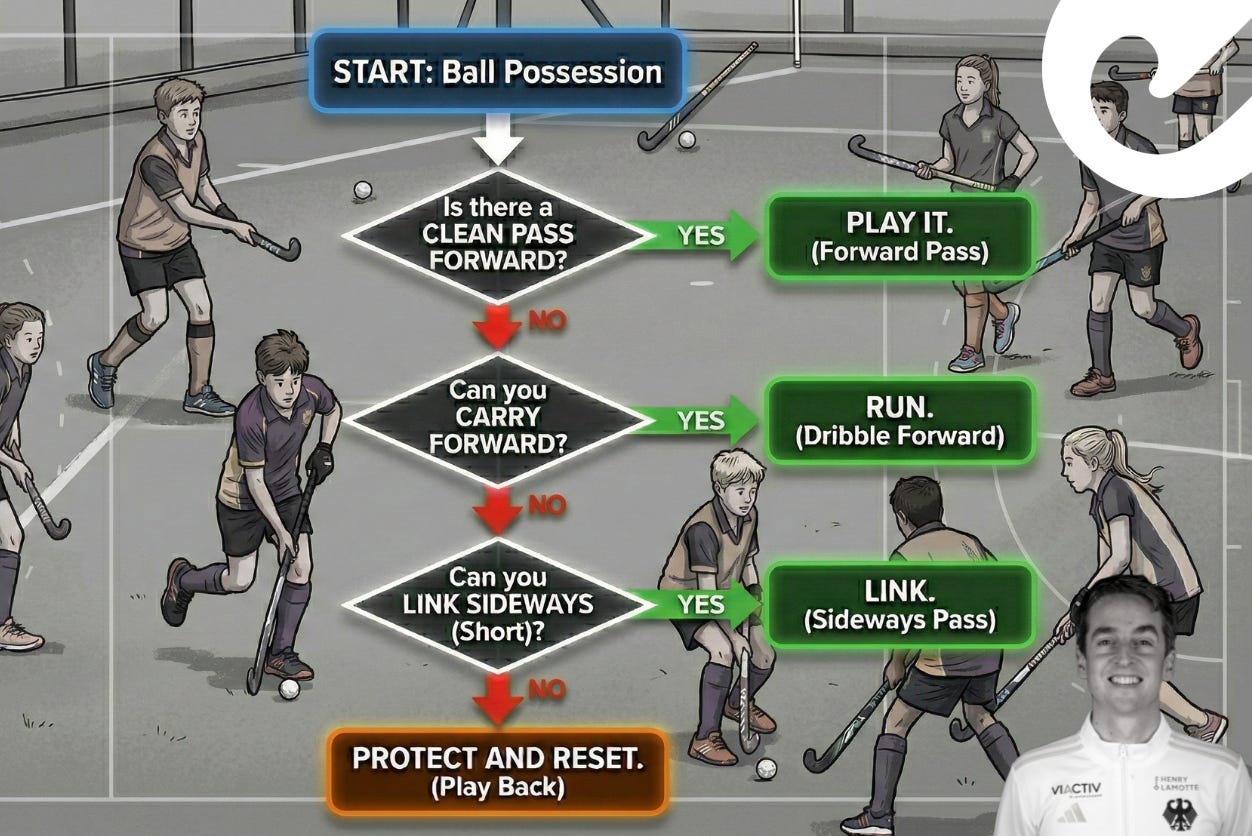
In the first 3 seconds after a regain:
Is there a clean pass forward? If yes, play it.
If not, can you carry forward? If yes, run.
If not, can you link sideways (short)? If yes, link.
If not, protect and reset (play back).
Enrich is clear on the priority:
“When you regain the ball… first priority, the first question is, is there a pass forward? … If the answer is yes, you have to play that pass.”
And:
“If that isn’t possible, then you have to run.”
Common mistake: the ball winner stops to “see what’s on,” which is basically donating time to the opponent.
Sideline cue that actually works: shout the first question, not the whole tree. “Forward?”
2) When you win it: the next two players decide if it becomes a counter or a mess
Every youth team has a ball winner.
The difference is what happens around them.
