

Fun lights the fire 🔥 Without it, nothing else sticks!
Part 1 in a series of 4 articles based upon the lessons from Coach K 🇺🇸 🏀 and several field hockey 🏑 experts sharing insights about fun, talent, culture and legacy.


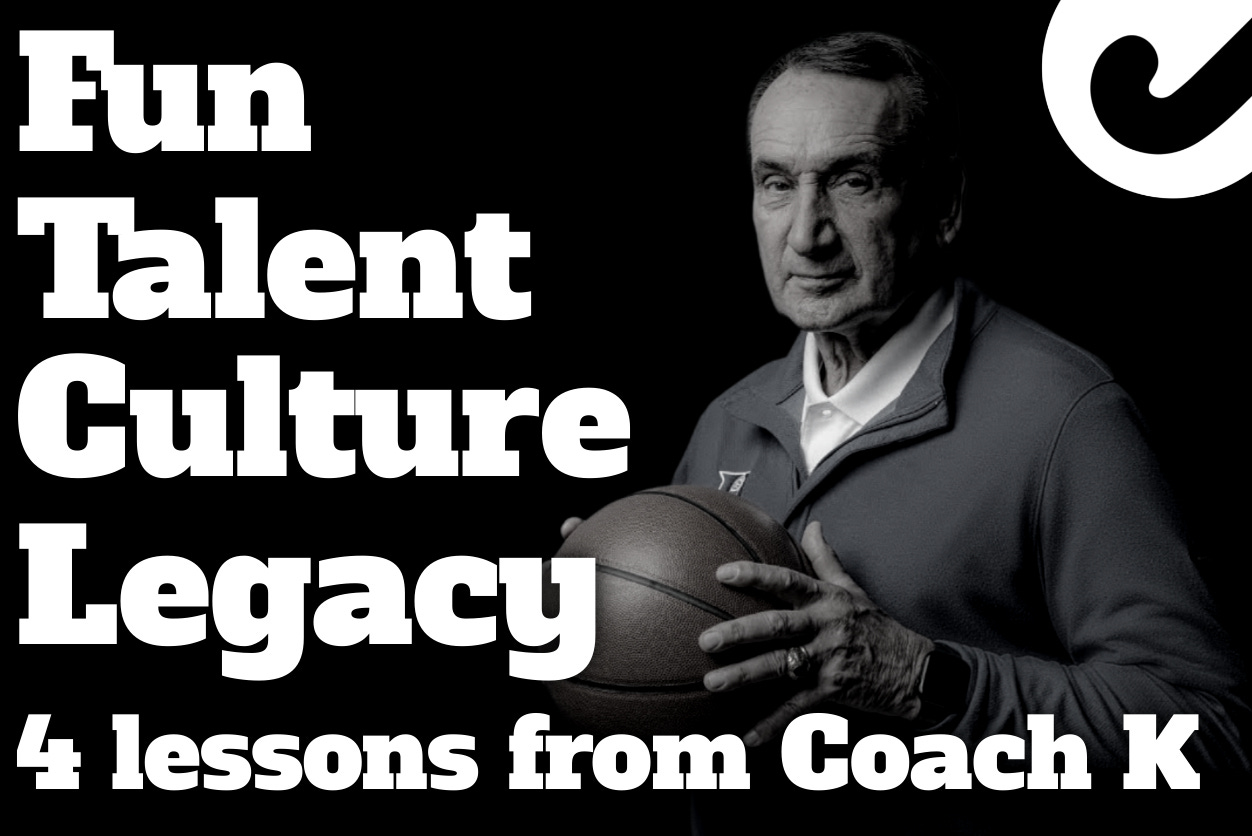
Enjoy the Ride! Did you know fun is the most underrated coaching tool in hockey?
Let’s be honest. Somewhere along the way, a lot of us started taking ourselves a bit too seriously. The sessions got more structured, the tactical boards got more detailed, and somewhere between the pressing patterns and the set-piece rehearsals, the laughter disappeared. Not completely, but enough to notice. And here’s the thing:
When fun goes, performance tends to follow it out the door.
Today, I want to make the case for fun as a genuine performance tool. Not the fluffy, participation-trophy kind of fun, but the real thing: the loose, energised, “I actually want to be here“ feeling that separates the environments where players grow fastest from the ones where they just go through the motions.
We’ll look at why a positive atmosphere is neurologically and behaviourally superior to a tight one, how your own emotional state sets the tone before you’ve said a single word, how to design sessions players genuinely look forward to, and how to keep the energy alive even when the scoreboard is against you. Along the way, I’ll draw on some hard-won wisdom from one of the greatest team builders in sport: basketball coach Mike Krzyzewski (aka Coach K) and from some of the best field hockey minds in our own catalogue here at The Hockey Site.
The Science of Loose vs. Tight
Coach K or Mike Krzyzewski, the most decorated coach in the history of college basketball, has a phrase that I keep coming back to. When one of his players was about to take a pressure shot late in a game, instead of loading them up with instruction, he said:
“I wish I was in your spot right now. What an opportunity.”
He said it with a smile. The player, loosened rather than tightened, stepped up and delivered.
That’s not luck. That’s a coach who understands something fundamental: a confident, loose atmosphere leads to better performance than a tight, fearful one. Coach K puts it plainly: “Creating a positive, loose atmosphere rather than a heavy one helps performance.” And he’s right. When players are anxious, their attention narrows, their decision-making slows, and they start playing not to lose instead of playing to win. When they feel safe, trusted, and yes, when they’re enjoying themselves, they play with the kind of freedom that actually unlocks their best hockey.
By the way the lessons from Coach K come from his masterclass here.
Performance psychologist Katie Warriner, who has worked with GB Hockey across multiple Olympic cycles, makes a similar point from a different angle. In her work on confidence, she draws a direct line between enjoyment and decision-making quality. When players are in a positive emotional state, the part of the brain responsible for good choices is simply more accessible. Fear and anxiety activate a completely different set of responses. The ones designed to keep you alive in a crisis, not to execute a well-timed aerial into the circle. As Warriner puts it, when players define success in ways within their own control rather than purely on outcomes, “you change everything around how your focus is, what you’re paying attention to, which in turn helps you make better decisions, which then helps you deliver a better performance.” You can explore her full thinking on this in her masterclass on confidence as a choice and a skill.
Fun, in other words, isn’t soft. It’s strategic.
It Starts With You
Here’s the uncomfortable truth: if you’re not enjoying your coaching, your players feel it. They might not be able to name it, but they sense the weight in the room the moment you walk onto the pitch. Coach K is emphatic on this point.
“Let emotion get the best out of you, not the best of you.”
He argues that leaders who embrace their own emotional energy — who bring genuine passion and enthusiasm to what they do — create a contagious environment. The ones who suppress it, or worse, who show up flat, create a different kind of contagion entirely.
This is something Mati Vila speaks to powerfully in his work on emotions, energy and team talks. The energy you bring into a team talk isn’t just background noise — it’s the message. Players pick up on your emotional state before they process a single tactical instruction. If you’re engaged, they engage. If you’re going through the motions, so will they.
So the first question to ask yourself honestly is: do I still love this game? Do I still love coaching? Do I still find the process interesting?
Tin Matkovic, in his masterclass on creativity in field hockey, makes the point that playfulness is the engine of creative play. But that engine has to be fueled by the coach first. The most creative players he’s worked with were not products of rigid systems. They came from environments where curiosity was valued, where trying something unexpected was celebrated rather than corrected. And that kind of environment doesn’t build itself. It gets built by coaches who are still genuinely curious themselves… and have fun every day on the field.
Coach K talks about making motivation a daily habit rather than saving it for pre-game speeches. He is always “on”, ready to seize the moment. That doesn’t mean being artificially cheerful or performing enthusiasm you don’t feel. It means staying connected to why you love this work… and letting that show.
Designing Sessions Players Actually Want to Come To
Practice design is one of the most direct levers we have when it comes to fun. And here’s where I’d push back gently on the idea that rigorous development and enjoyment are opposites. Coach K’s approach to practice is instructive: keep sessions short, quick, and game-like. Not because it’s easier, but because it’s more effective. When the training environment mirrors the competitive environment, with its unpredictability, its decisions under pressure, its moments of individual brilliance, players engage at a different level. They stop executing a drill and start playing hockey.
Andreu Enrich, in his masterclass on learning environments, goes deeper into what makes a training session genuinely engaging rather than just busy. The difference, he argues, lies in intentionality. Designing the session around specific behaviours you want to see, and then creating the conditions where those behaviours naturally emerge. It’s not about making things easy. It’s about making them meaningful. When players understand why they’re doing something, and when they can feel the connection between the training activity and the real game, the engagement is automatic.
Lisa Letchford, in her session on basic skills through small-sided games, makes a point on SSG’s that any coach working with any age group will recognise immediately:
“It’s really active, so people love it, it’s really enjoyable. Little kids, big kids, equally, I’m a big kid and I love playing gameplay more than I do running around a cone.”
The small-sided game format is fun by design. It puts players in constant contact with the ball and with each other, it creates natural pressure and natural release, and it allows the coach to observe and reinforce the things that actually matter. The skill development that happens inside a well-constructed small-sided game is often deeper and more durable than what happens in an isolated drill, precisely because the player is engaged, challenged, and enjoying themselves all at once.
The session that feels like work is rarely the session that produces the breakthrough.
Keeping the Fun Alive Under Pressure
This is where most coaches will push back. Fun is great in a development session on a Tuesday evening, sure. But what about the league decider? What about the tournament final? What about the away game when you’re a goal down and everything is tight?
This is exactly where Coach K’s Tone-Time-Place framework becomes useful. His point is that the approach has to be read from the situation, not predetermined. Sometimes a team needs firing up. More often than people think, they need to be loosened. He shares the story of a player who had stopped shooting. Stuck in his own head after a few misses, retreating from the game. His player wasn’t missing shots because he’d forgotten how to shoot. He was missing them because the weight of each miss had become heavier than the shot itself. Every subsequent attempt carried the baggage of the last one. That’s a confidence spiral every coach has seen and most of us have tried to fix it with technical feedback, encouragement, or extra reps in training. Coach K did none of those things.
Instead, he redistributed the psychological load. “Every shot you take is my shot.“ Six words that effectively said: this is not yours to carry alone. I’m in it with you. Miss it, that’s on me too. Suddenly the shooter is no longer a solo actor trying not to fail. He’s part of a partnership. And that shift, from isolation to connection, from individual burden to shared responsibility, is often all a player needs to get back to playing naturally.
In field hockey terms, think of the striker who stops arriving in the circle after a string of missed one-on-ones. Or the penalty corner drag flicker who starts doubting instead of flicking it. The technique hasn’t gone anywhere. What’s gone is the freedom. And you can’t coach freedom back into someone by adding more instruction. You coach it back by taking something away: specifically, the fear that the next mistake is theirs alone to own.
That’s the environment Coach K is describing. Not one where mistakes are ignored, but one where they are shared. Where the coach’s relationship with the player is strong enough that the player knows: I won’t be abandoned when I’m struggling. That level of trust doesn’t come from one good line at the right moment. It comes from dozens of smaller moments across weeks and months where the coach has consistently shown up the same way. That’s emotional intelligence applied to performance and it’s the kind of move that only works in an environment where the player trusts that mistakes are part of the process.
Katie Warriner makes a similar point about confidence under pressure: it’s a behaviour, not just a feeling. Players can choose to behave confidently, to carry themselves, communicate, and act as they would when they’re at their best. Even when the internal experience doesn’t quite match yet. “The behaviors are way more in our control than the feelings. And the feelings might come after behaviors.” That’s a skill coaches can actively develop, but only in environments where it’s safe to practise it. Environments, in other words, where fun has been protected long enough to become a foundation.
The coach who screams at every mistake doesn’t just damage confidence. They make it impossible for players to develop the loose, decisive boldness that good hockey requires. Conversely, the coach who reads the room, who knows when to ease the tension with a well-timed word or a genuine laugh, creates the conditions for their players to perform when it actually counts.
What We’re Really Talking About
Let me bring this back to where we started. The best coaches are not just tacticians. They are environment builders. And the most effective environment isn’t the most intense one, or the most disciplined one, or even the most structured one. It’s the one where players want to be. Where they feel energised when they arrive and leave having genuinely enjoyed the work.
Coach K, reflecting on decades at the top of his sport, distils it simply:
The goal is for your team to “enjoy achieving the goal enough that they want to do it again.” That’s sustainability. That’s the coaching that compounds over years rather than burning out in a single season.
So here’s the recap, from one coach to another. Fun matters for performance! The neuroscience is clear, and the best coaches in multiple sports have built entire cultures around it. Your emotional energy sets the tone before a word is spoken, so bring something real. Design your sessions to be game-like and meaningful, and let the engagement take care of itself. And when the pressure is highest, remember that loosening the grip is often more powerful than tightening it.
Enjoy the ride. Your players will too.
Keep your eye out for the follow up articles on talent, culture & legacy 😉
Some of the sources mentioned:
Confidence: a choice and a skill

✅ What if confidence in your players isn’t just something you’re born with, but a skill you can actually train?
Emotions, Energy, and Engagement: Building Better Team Talks with Mati Vila

When it comes to team talks and effective communication as a field hockey coach, the one lesson that stands out from Mati Vila’s masterclass is this:
About Feedback, Anchor Tasks, Managing Arousal and so much more

When reflecting on the recent masterclass with Andreu Enrich, there’s one insight that stands above the rest for field hockey coaches: the transformative impact of purposeful, integrated feedback in your daily coaching.