

Lessons on communication and thinking from Neil deGrasse Tyson - 4/4
8 lessons field hockey coaches in 4 weeks from Neil deGrasse Tyson's insights on Scientific Thinking and Communication. This is week 4/4.


So the previous weeks we talked about understanding that being right isn’t enough without effective communication, about recognizing cognitive biases in player evaluation, about embracing scientific thinking and tailoring your messages to different athletes. And of course about knowing what to measure and progressive teaching.
Today we’re addressing the final two, lessons seven and eight from astrophysicist Neil deGrasse Tyson, applied to field hockey coaching 😉
TLDR;

Neil deGrasse Tyson, one of the world's great thinkers, shares his insights in how to think, teach, and communicate more effectively. This series of articles explores eight essential lessons from one of the world’s greatest science communicators that directly apply to coaching field hockey: understanding that being right isn’t enough without effective communication; recognizing cognitive biases in player evaluation; embracing the scientific method in tactical innovation; tailoring communication to different athletes; using progressive teaching strategies; measuring what matters; leveraging body language; and fostering genuine curiosity in your players. These aren’t abstract concepts. They’re practical tools that can transform how you develop players, implement tactics, and build winning programs.
For four consecutive weeks we shared two lessons each week with you.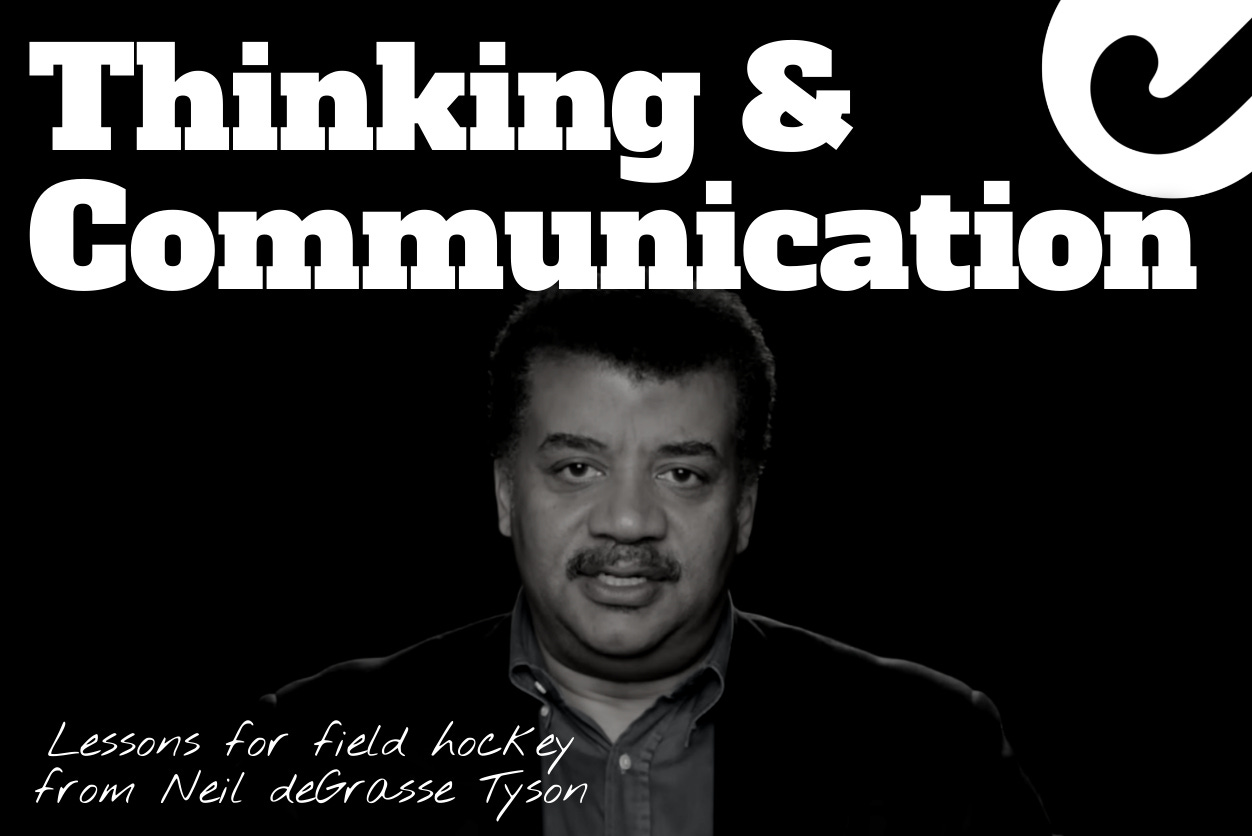
When Science Meets Sports
When Neil deGrasse Tyson delivered a masterclass on Scientific Thinking and Communication it wasn’t only about astrophysics, his field of expertise. It’s about how we discover truth, overcome our biases, and communicate complex ideas effectively. These are precisely the skills that separate good coaches from great ones.
In this last post of a series of four posts we’ll explore two more lessons from Tyson that directly apply to coaching field hockey at competitive levels. Learning from Tyson’s insight that teaching topics in a progressive way makes more sense compared to throwing it all at them in one go. Foster curiosity! We also explore how to leverage body language. Your body never shuts up. Make sure it’s saying what you want it to say.
Today its about lessons five and six we wanted to share, based upon the masterclass given by Neil deGrasse Tyson. But make sure you also take a look at these earlier posts:

→  Danny Kerry: World Cup 2023 panel talk
→  Simon Blanford: How data analysis can change your team’s circle behavior
→  Simon Blanford: A gentle introduction to data analysis in hockey
These lessons aren’t theoretical—they’re immediately applicable to your training session tomorrow, your team talk on gameday, and your season planning for next year. Let’s go….
Lesson 7: Your Body Is Talking—Make Sure It’s Saying What You Want
You’re delivering your pre-match talk. You’re explaining the defensive structure, the pressing triggers, the patient build-up you need. Your words are perfect. But your arms are crossed, you’re shifting your weight nervously, and you keep glancing at your notes.
Your players hear two messages: the confident tactical instruction from your words, and the uncertainty from your body. Which one do you think they believe?
Tyson understands this from experience: “Words communicate, yes. The spoken word can do a very good job. But you’re not limited to that. You can have facial expressions. You can smile. You can look sad. You can tip your head. You can have hands you can gesture with. You have eyebrows. Why not allow your body to participate in the act of communicating?”
His background in dance gave him “a self-awareness of my body parts, my limbs. I know what my arm is doing and what it looks like as I do so.” Most coaches don’t have this training, but we need this awareness because communication isn’t just verbal—it’s physical, and your body is always communicating something.
Consider the coach who delivers their team talk sitting down versus standing. The coach who stands still behind a whiteboard versus walks among the players. The coach who makes eye contact versus looks at their notes. The coach who demonstrates movements versus just describes them.
Physical Demonstration
When teaching tactical movements, Tyson’s insight is crucial: “Now the person heard your words and they saw you. They have double force operating on their senses.”
Instead of saying “The left winger needs to make a diagonal run from wide to central when we switch play,” stand up, move from wide to central, and show the run while explaining it. Your players now have verbal and visual information. Add a ball and have them do it themselves, and you’ve engaged kinesthetic learning as well.
This is especially critical for spatial concepts. Explaining positioning in a press is abstract; physically positioning yourself and your players in the space while explaining it is concrete.
Your Emotional State
Your body language reveals your emotional state to your players, whether you intend it to or not. In crucial moments—after a poor first half, before a big match, during a losing streak—your players are scanning you for signals about whether to be confident or concerned.
If you’re nervous about the opposition’s striker, and you unconsciously keep glancing at her during warmups, your defenders will notice and their anxiety will increase. If you’re frustrated with your team’s performance, and your body language shows it (crossed arms, tight jaw, short movements), they’ll feel your frustration even if you say “let’s stay positive.”
This doesn’t mean fake confidence you don’t feel—players are excellent at detecting inauthenticity. It means being aware of what your body is communicating and ensuring it aligns with your message.
Movement and Energy
Tyson describes his preference: “I don’t give talks from behind a podium. I could, I’d prefer not to. Give me a roving microphone and I’ll walk the stage.” There’s a reason for this—movement creates energy and engagement.
The coach who stands still in one spot for an entire training session communicates something different than the coach who moves around the field, positioning themselves at different angles, getting close to individual players, demonstrating movements. Which coach seems more engaged? Which one would you rather play for?
This doesn’t mean constant frenetic movement—that communicates anxiety. But deliberate, purposeful movement around your training space shows you’re engaged with what’s happening everywhere on the field, not just in one zone.
Voice Modulation
Tyson also emphasizes vocal variety: “It also involves modulating your voice. Look at how many people just deliver monotone. That’s not interesting.”
A monotone delivery suggests either uncertainty or disinterest. Neither is what you want to communicate. Varying your volume, pace, and tone emphasizes key points, maintains attention, and conveys emotional context.
Critical defensive instruction before a corner: slow, clear, emphatic. Celebrating a training goal: fast, energetic, loud. Correcting a technical error: calm, measured, instructive. Same coach, same players, different contexts requiring different vocal delivery.
Start recording you voice as a coach during training sessions, from beginning to end. It could teach you a lot…
Practical Application
Record yourself giving a team talk or running a training session. Watch it with the sound off. What does your body language communicate? Are you confident, engaged, energetic? Or uncertain, distant, lethargic?
Then watch it with sound on but without looking at the screen. Does your voice convey what you intended? Are key points emphasized? Is your energy level appropriate to the message?
This self-awareness is uncomfortable but invaluable. As Tyson notes: “If you have a way to access someone’s senses, do so. It will double your effectiveness in that instant.”
Your body is always communicating with your players. Make sure it’s saying what you want it to say.
Adam Commens, high performance director for Hockey Belgium, highlighted the impact of body language on players, stating, “Just being quiet maybe doesn’t hide the fact that you’re frustrated. Does that frustration affect the players on the pitch? Does your body language affect them?” This emphasizes the importance of self-awareness in how coaches present themselves to their teams
Never hesitate to Assistant.Hockey more tips about this from the many other coaches we hosted in our masterclasses and workshops. If you’re already a paying subscriber… thank you 🙏 and please read on for the next lesson on cognitive bias. If you’re not yet a paid subscriber, join us to get the most out of what we share here 😉 and make sure you explore the previous posts if you haven't yet.Lesson 8: Cultivate Curiosity, Not Compliance
The most important insight from Tyson’s masterclass might be the one least directly related to coaching technique: the value of curiosity over compliance.
Tyson states it simply: “The most important thing you can be in life is curious. Curious about things you don’t know. Curious about things you do know. Or that you think you know, but that there’s more to learn about it. Curious about why other people think differently from how you think.”
Most coaching systems are built on compliance: the coach knows what to do, explains what to do, and the players do what they’re told. This works—to a point. It works for executing set patterns, for maintaining defensive shape, for implementing straightforward tactics. But it fails when the game situation doesn’t match the pattern, when the opponent does something unexpected, when a split-second decision must be made without coach input.
The compliance model produces players who execute instructions. The curiosity model produces players who understand the game.
Ask, Don’t Tell
Instead of: “When their left defender has the ball, you need to press her forehand side to force the ball to her backhand.”
Try: “Watch their left defender on this video clip. Where do you think we should force her to play? Why? What happens if we press the other side?”
The first approach is faster. The second approach is better. Why? Because the player who understands why we press this way, is the player who will recognize when the situation changes and adapt their pressing angle. The player who was simply told what to do will continue pressing to the forehand of that left defender because that’s what they were told.
Tyson emphasizes this point: “Curiosity allows us to benefit from what other humans have worked hard to discover... The more you can stoke curiosity, the more you can live a life reaping the benefits.”
The Socratic Method in Coaching
After a training drill, instead of immediately explaining what went wrong and how to fix it, ask your players:
“What did you notice about their defensive positioning?”
“Where was the space?”
“What stopped us from exploiting it?”
“What could we do differently next time?”
This takes longer. It requires patience. You might have to bite your tongue while players offer imperfect answers. But the understanding they build through this process is their understanding, not yours transplanted into their heads.
Create Thinking Players
Tyson’s approach to education is to stimulate your curiosity. And curiosity is never fed by dumping a bucket of water on someone. It’s fed by giving them a taste of it.
Apply this to your tactical education of players. Don’t give them the complete tactical manual in preseason. Give them principles and let them discover applications. Give them problems and let them discover solutions (with guidance when they get stuck).
Example: Instead of installing a complex press system with 15 rules about who presses when, teach them the principle: “We press to prevent forward progress and force turnovers.” Then let them experiment in training drills. When they make mistakes, ask: “Did that press prevent forward progress? No? What could you do differently?”
They’ll make mistakes the compliance model would have avoided. But those mistakes are learning opportunities that build genuine understanding.
The Long-Term Payoff
Curious players:
Solve problems during matches without needing coach instruction
Adapt when opponents change tactics
Continue developing after they leave your program
Become coaches themselves, spreading your tactical philosophy
Compliant players:
Execute what you’ve taught them
Struggle when the game situation doesn’t match training
Stop developing when they leave your program
The curiosity model requires more trust in your players and more patience with their development process. But as Tyson notes about his teaching approach: “They get curious and then later on they research it more themselves, preserving the interest that I was able to establish with that entry-level information.”
Do you want players who can execute your tactics, or players who understand hockey? The first is easier to coach. The second wins championships.
As Tyson concludes: “If you stimulated the curiosity within them, they’ll get there on their own.” Your job isn’t to fill your players’ heads with information. It’s to make them curious enough to fill their own heads—and to guide them in the right direction as they do.
Conclusion: From the Cosmos to the Circle
Remember that evening from the day after, replaying your match in your head for the hundredth time? You were right about what went wrong. But you weren’t effective at fixing it. You saw the tactical adjustments needed. But you didn’t communicate them in a way your players could understand and execute. You evaluated your players’ performances. But you didn’t account for your own cognitive biases.
Neil deGrasse Tyson teaches us about scientific thinking and communication. But really, he teaches us about teaching itself—how to discover truth, communicate clearly, and overcome the limitations of human cognition. These are exactly the skills coaches need.
If you implement nothing else from this article, implement these three takeaways tomorrow:
1. Before Your Next Training Session: Take your key teaching point and prepare to explain it three different ways for three different types of learners. Don’t just plan what to teach—plan how to teach to different audiences within your single team. Ask yourself: “How will I know they truly understand this?” Be ten times more prepared than you need to be.
2. After Your Next Match: Identify one judgment you made about a player’s performance. Now actively look for evidence that you were wrong. Review video specifically looking for contradictory evidence to your initial assessment. Force yourself to be objective about a subjective evaluation. Write down what you discover.
3. This Week in Training: Take one tactical concept you usually explain and instead pose it as a question. Instead of telling your players what to do, ask them what they think should happen and why. Let them struggle toward the answer. Guide, don’t dictate. Cultivate curiosity, not just compliance.
These aren’t abstract academic exercises. They’re practical applications of scientific thinking to the daily work of coaching field hockey. They’re how you bridge the gap between being right about hockey and being effective at teaching hockey.
As Tyson’s father told him, and as he shares with us: “It’s not good enough to be right. You also have to be effective.”
You know hockey. You’ve studied it. You’ve earned your coaching levels. You’re right about what your team needs to improve.
Now it’s time to become effective at making that improvement happen.
The next training session starts tomorrow. You have a choice: deliver the same tactical talk the same way you always have, or experiment with a new approach informed by scientific thinking and communication principles.
Do whatever it takes not to fool yourself. Measure what matters. Know your biases. Tailor your message. Build understanding progressively. Use your whole body to communicate. And above all, make your players curious.
That’s how you turn tactical knowledge into on-field performance. That’s how you develop not just better players, but thinking players. That’s how you become not just a coach who knows hockey, but a coach who can teach hockey.
The cosmos may be 13.8 billion years old, but your next opportunity to apply these lessons is just hours away. Make it count.
If you haven’t already, don’t forget to take in the previous lessons from this series ↓
