

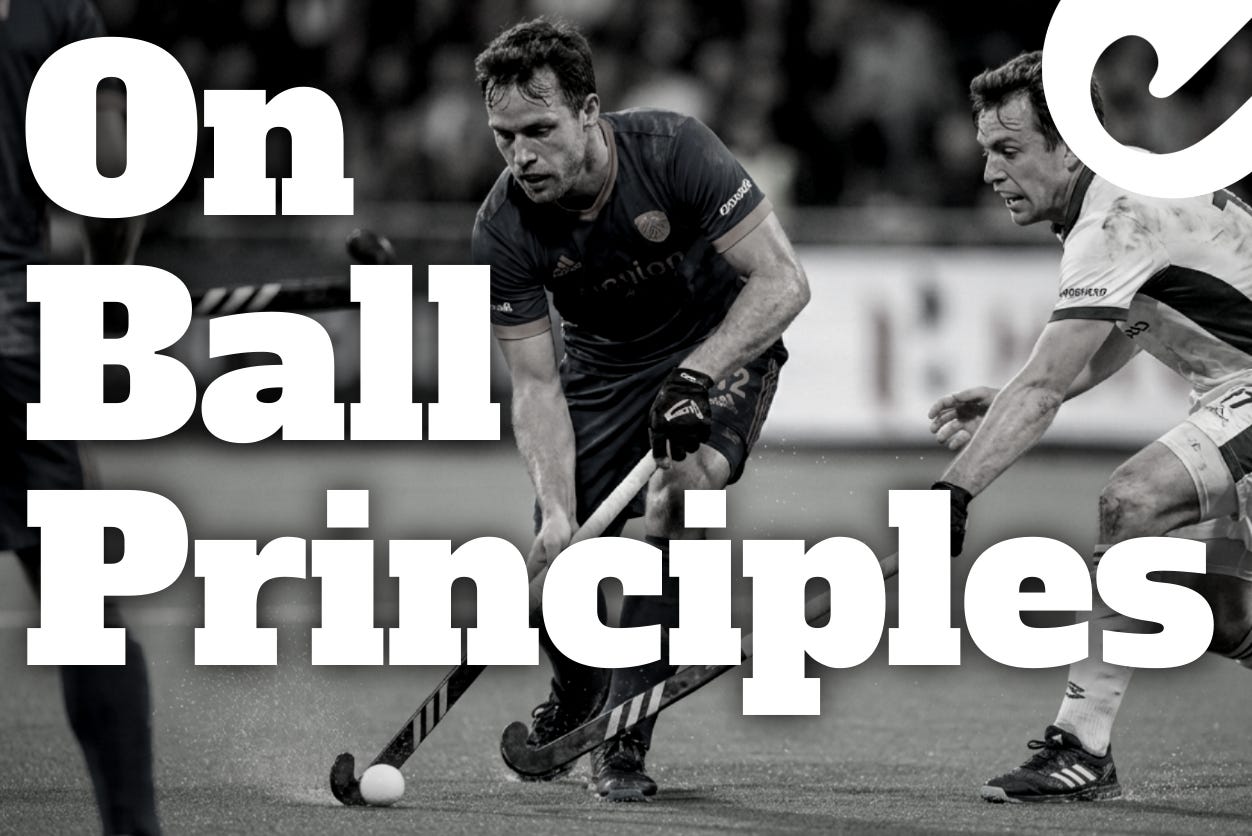
On Ball Principles
How to coach the rules you want your players to understand when in possession of the ball


You know the player. In drills, their technique looks clean. The pass is crisp. The receive is tidy. But put them into a match where the pressure arrives half a second earlier than expected, and suddenly the “same” skill falls apart. Not because they forgot how to trap a ball, but because the picture changed and their decision-making did not keep up.
And here’s the part that stings a bit as coaches: we can run a session full of technically correct reps and still create a team that makes poor on-ball choices when the game goes chaotic. The skills exist, but the skills are not living inside a decision framework. So the players freeze, force it, or over-carry until the moment is gone.
That is exactly where on-ball principles earn their keep. They are the behavioural rules that show up when time and space disappear, and they are coachable across youth, experienced players, and of course mixed-skill teams.
TL;DR
On-ball principles are the “defaults” players fall back on under pressure: how they scan, receive, protect, eliminate, and choose tempo. Coach them as decisions in context, not isolated technique. Youth need simple cues and repeatable pictures. Experienced players need sharper constraints and more autonomy. Mixed ability groups need one theme with multiple entry points, so everyone trains the same principle at their level. Use constraints to create behaviour, and language to create alignment.
Some of the sources used to distill these principles if you want to take a closer look at it all
The 3-Second Decision Framework for Receiving Under Pressure
Scan-to-First-Touch Under Pressure: What to Coach When the Picture Changes Late
And just you know, earlier we also wrote about the off ball principles of course 😉 ↓
Off Ball Principles

Off-ball principles are one of the most overlooked yet critical aspects of field hockey. While much of the focus in training often revolves around what players do with the ball—passing, dribbling, shooting—it’s important to remember that the majority of the game is played without it. As once pointed out during a masterclass with Ben Bishop:
Back to our On Ball Principles now…
What on-ball principles actually are
A skill is “can you execute a reverse-stick receive?”
A principle is “what do you do with that receive when the defender steps, your forehand is shut, and the passing lane closes late?”
So on-ball principles are repeatable decision rules that connect perception → decision → execution. They are not a list of moves. They are what players use to choose the move, at the right moment, with the right level of risk.
A clean way to explain it to coaches and players is the “short window around reception” idea. In the 3-second window around receiving, the player must scan, position, control, and act with purpose, or the opponent arrives and the whole moment collapses.
And when you zoom in on real match moments, you see these principles showing up again and again:
Scan with purpose, not as a ritual. A shoulder check should answer: Where is the nearest pressure? Where is my safe exit? Where is my damaging exit?
First touch is a tactical action. Your touch must buy time, buy space, or buy protection. If it buys nothing, it is “control” that still loses possession a second later.
Tempo is a choice. Not always fast. Not always safe. The best players speed up when the picture is favourable, and slow down when chaos would create a turnover.
Eliminate when it creates advantage, not because you can. Especially at higher levels, the reception itself can eliminate a defender if the touch and body shape take you away from pressure and toward a damaging exit.
That’s the headline: principles give players a “next best action” when the game removes certainty.
Teaching on-ball principles to youth teams: simple cues, habits, transfer
With youth, the biggest trap is over-coaching the language and under-coaching the picture. You give them ten coaching points, and they remember none of them in the match because they never owned the why.
So teach youth on-ball principles with three habits, and keep them ridiculously consistent across the season.
Habit one: “Find pressure early.”
This is scanning, but youth don’t need a lecture on perception. They need a question they can answer quickly: “Where is the closest defender coming from?”
Habit two: “Face where you want to play.”
Even with developing technique, body shape is the cheat code. If a player receives square, they are already late. If they receive half-open, they have options even with an average first touch.
Habit three: “First touch buys something.”
Youth often think the receive is the end of the job. It is the start. So coach the touch as intent: touch into space, touch away from pressure, touch into protection.
Now, the transfer piece. Youth don’t transfer learning from unopposed reps. They transfer from constraints that force the principle to appear. That is why small-sided games matter so much: they repeatedly create the same pressure pictures and force decisions at speed, without you having to artificially “tell” them what to do every rep.
If you want youth to get better at receiving under pressure, do not start with “perfect receiving”. Start with: “can you scan, receive half-open, and play the safe exit under time pressure?” Then, week by week, you make the safe exit smaller, the damaging exit more attractive, and the pressure more realistic.
Reinforcing and sharpening on-ball principles with experienced players: detail, constraints, autonomy
With experienced groups, the coaching problem flips. They already know the words. They already have skills. What they need is sharper standards and better problems to solve.
