

Pressure is a matter of perception
When the opponent is pressing, not all players experience this the same way


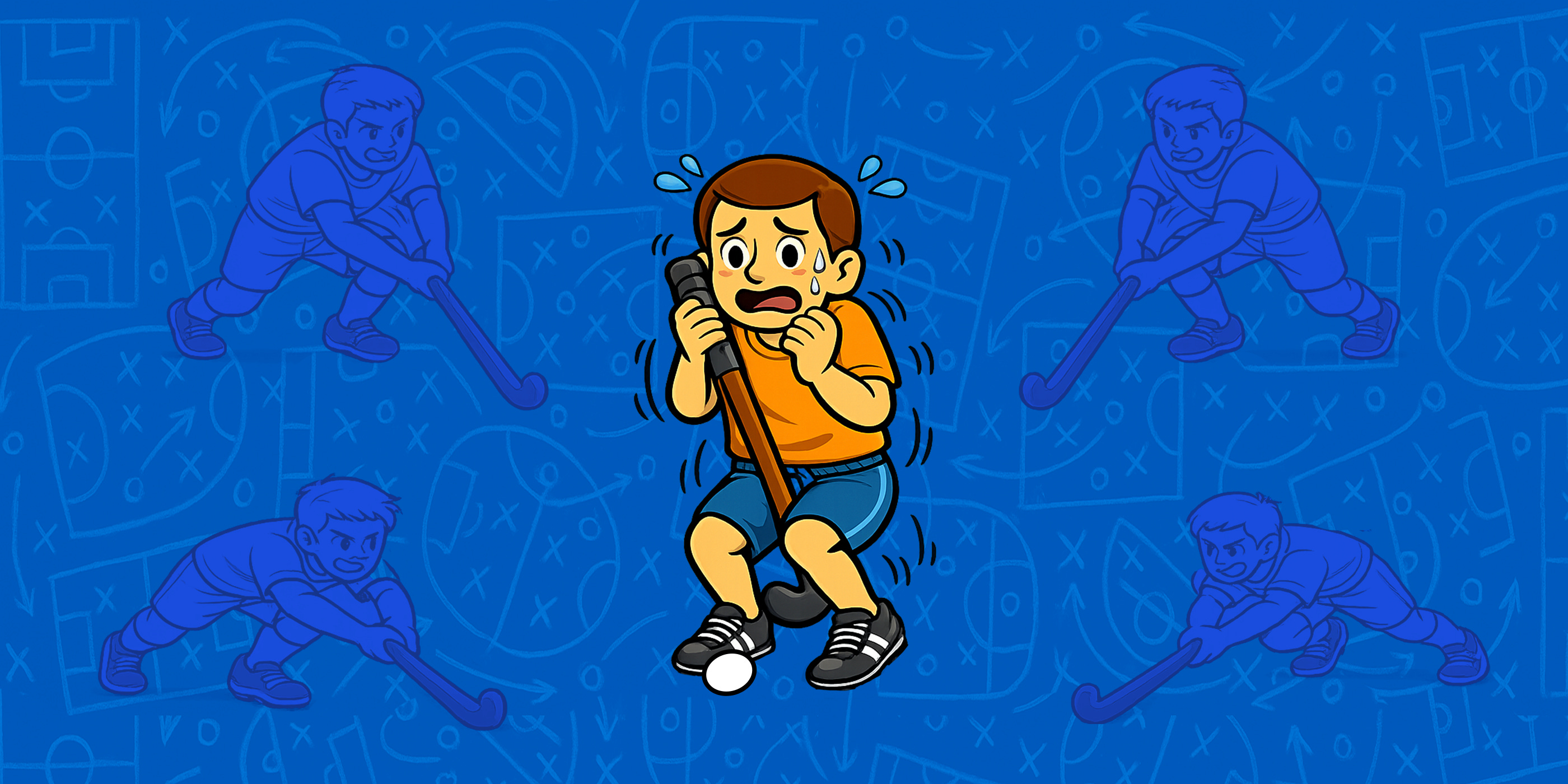
Situation A: A centre-back offers a passing option. He sees how his teammate gets ready and makes the pass. At the same time, he notices how an opposing forward immediately starts sprinting towards him at full speed. He gets scared. The reception is poor, the ball bounces off his stick. The forward steals it and goes towards the circle against the goalkeeper.
Situation B: A centre-back offers a passing option. He sees how his teammate gets ready and makes the pass. At the same time, he notices how an opposing forward immediately starts sprinting towards him at full speed. He sizes him up and waits for him. When the ball arrives, with the first touch he already eliminates him. He moves up towards the next line of pressure, having already created numerical superiority.
Beyond how the player who received the ball resolves the situation… Is there any difference in the pressure?
The answer is clearly no. The forward does exactly the same thing in both situations.
What changes, beyond the final outcome, is how the player with the ball experiences it.
Personal experience
At 17 I started playing as a centre-back in my club’s first team. For three or four years, every build-up from the back was a stressful situation for me. When the ball went over the backline for a restart, I already started to suffer.
Over time that changed. Later on, not only did it stop causing me tension, but I even started to enjoy trying to find the solution to the presses.
The pressure hadn’t changed. I had.
It’s logical that this happens with growth and experience.
But then… As coaches, how do we help accelerate that process?
🧰 The toolbox
I’ve always liked the analogy between technical skills and a toolbox. Every technical action is one more tool I can use.
If I want to build a chair and I only have a screwdriver, it will be difficult.
If I also have a saw, a hammer and pliers, I have many more possibilities.
If I want to get out of a pressure situation and I only know how to use the sweep, it will be difficult.
If I also know how to use the sweep, the push and the flick, I have many more chances.
Our first objective as coaches is to try to provide our players with as many tools as possible.
🧠 The mind
The next step, and perhaps the hardest to develop, is the mental side: the player’s intelligence. That they understand the game they are playing.
I can have the most technically complete player in the world, but if when they have to cut a piece of wood they use a screwdriver, having so many resources is of little use.
Same if they need to make a five‑metre pass and choose a hit.
In my opinion, an intelligent player is not necessarily the one who has the most resources, but the one who knows which one to use from those available. Who knows their limitations and knows how to make the most of them.
I’ve seen elite players without so many technical resources, but with superior intelligence.
Of course, intelligence and understanding are harder to train and many times we think they’re just a genetic lottery.
But that’s not reality. We can and must make the effort to work on these capacities.
In training, we should try to ensure that all, or almost all, exercises include decision‑making. The more situations they encounter where they have to choose, the more they will develop that ability.
Ask questions, a lot. Make players reflect, make them think about what they are doing and not act on autopilot. Open questions help them think.
Use video. And not as opponent analysis to win a match, but as self‑analysis to grow. Let them watch themselves. Let them see, with the overhead camera, things they didn’t see while playing. Let them correct each other.
These are just some of the ways we can develop understanding. In one team I coached, we even did theoretical exams as a joke: multiple‑choice questions projected on a screen and a live leaderboard for who answered best.
There are many ways to work on it.
🎉 The environment
One detail I don’t want to overlook is that, when it comes to training understanding, the type of environment we create is fundamental. And when I say this, I mean the “vibe” in the air, especially when we work with kids.
It has to come from good energy and respect. Players need to feel that when we ask them a question, we’re not giving them a test to see whether they know the answer or not, but that we’re trying to get them to think for themselves.
They have to learn to live with error, and this is impossible if they’re afraid the coach will scold them when they do something wrong.
When we talk about pressure as perception, fear plays a fundamental role. I can have all the resources and enough intelligence, but if I’m afraid, none of that gets used.
I don’t want to go deep into neuroscience, but it’s proven that when we’re stressed, the brain responds more by reflex than by reflection.
And I don’t want to forget this: beyond what’s ideal for learning, there is the person. If we take care of the person, everything else flows.
Laughing at mistakes so we can try to learn from them. Celebrating small achievements.
When we enjoy ourselves, we are more open to learning.
As coaches we have enormous power over our players’ self‑esteem. And we must assume that with the responsibility it deserves.
➡️ Conclusion
When a player receives the ball, the opponents are going to chase them anyway. That pressure will always exist.
The difference won’t be in the speed at which they come, but in the preparation and understanding of our player.
If they have tools, they’ll have more options.
If they understand the game, they’ll choose better.
If they feel confident, they’ll dare to try things.
The pressure will always be there.
It’s up to us to try to turn that threat into an opportunity.
Until next time!
Javi
 | A guest post by
|