

Recovering Shape After a Broken Press: The 4-Second Reset
Based upon the masterclasses & workshops by Andreu Enrich, Fede Tanuscio, Russell Coates & co ...


You know the feeling. Your team’s press is working beautifully—until it isn’t. One well-timed pass splits your first line, suddenly your midfield is scrambling, and before you know it, you’re watching a 3v2 bear down on your circle. The press didn’t just fail; it created the very danger it was meant to prevent.
Here’s the uncomfortable truth: most teams spend most of their defensive preparation on how to press, and probably a lot less on what happens when that press breaks. Yet the moments immediately after a press is bypassed are often the most dangerous in the entire match. Get those first few seconds wrong, and you’re not just conceding possession. You’re conceding high-quality chances.
This article is about those critical seconds. Not the press itself, but the recovery. Not the ideal scenario, but the messy reality when your structure fractures and you need to rebuild it before the opposition punishes you. And yes, it’s a long read… but worth it we think ;)
TLDR:
When your press breaks, you have roughly 4 seconds to reorganize before danger develops. This framework gives players three clear roles—Delayers (apply immediate pressure), Deniers (close passing lanes), and Droppers (get goal-side)—plus decision triggers for when to re-press versus reset. Master the recovery, and you'll maintain defensive solidity even when your primary plan fails.
Read it all to discover the training progressions that make this automatic, the common breakdowns that lead to catastrophic counters, and the advanced variants for elite teams to turn defensive chaos into their next attacking opportunity.
We’ll address:
- The reality of the Modern Broken Press
- The 4 Second Reset Framework
- Avoiding the Catastrophic Counter
- Decision Triggers
- Training the Reset
- Troubleshooting the Reset
- Why This Matters
- More Advanced Variants and Creative Strategies

Some of the sources used:
- https://my.thehockeysite.com/p/managing-transitions
- https://my.thehockeysite.com/p/rest-defence-in-field-hockey
- https://my.thehockeysite.com/p/defensive-system-variants-and-pressing
The Reality of the Modern Broken Press
Let’s start with what we’re actually dealing with. When I say “broken press,” I’m talking about the moment when the opposition successfully plays through or around your pressing structure. This could be a sharp vertical pass that eliminates your first line, a diagonal ball that exploits the space between your units, or even just a series of quick passes that pull your players out of position.
The thing is, presses break all the time. Even at elite level, even with the best teams. Andreu Enrich, who coaches in the German Bundesliga and with the German national team, frames it perfectly in his work on managing transitions: there’s a moment after every loss or bypass where the game is completely open, where neither team has proper organization, and that moment is absolutely critical.[1]
The problem isn’t that presses break—that’s inevitable. The problem is what happens next. Do your players have a clear understanding of their roles in those chaotic seconds? Do they know when to keep pressing and when to drop? Most importantly, do they have a framework that allows them to make those decisions quickly and collectively?
This is where the 4-Second Reset comes in.
The 4-Second Reset Framework
The name is deliberate. Four seconds isn’t arbitrary—it’s roughly the window you have between the moment your press is bypassed and the moment the opposition can create a dangerous attacking situation. Miss that window, and you’re defending a counterattack. Use it well, and you can reestablish defensive shape before the danger truly develops.
But let’s be clear about what this framework is and isn’t. It’s not a rigid system where everyone has a predetermined position. It’s a set of principles that allow your players to reorganize quickly based on where the ball is, where the opponents are, and where the biggest danger sits.
Fede Tanuscio, who has worked extensively on defensive transitions at international level, emphasizes that in these moments you’re not defending positions—you’re defending intentions.[2] In the first two to three seconds after your press breaks, you need to read what the ball-winner wants to do. Are they looking to play forward immediately? Are they trying to switch the play? Are they looking to find a central player who can turn and face your goal?
This reading of intention is what separates teams that recover effectively from teams that just chase.
The Three Roles: Drop, Delay, Deny
Within the 4-Second Reset, every player falls into one of three roles depending on their position relative to the ball when the press breaks:
The Delayers are your front-line players—typically your forwards and maybe an advanced midfielder. When the press breaks, their job isn’t to win the ball back (though if they can, great). Their job is to apply immediate body and stick pressure on the ball carrier, denying them time to scan forward and play the dangerous pass. As Tanuscio puts it, you hold your position, you keep your body shape, and you make it difficult for them to execute cleanly.[2] You’re buying time, not committing to tackles you probably won’t win.
The Droppers are your deepest players—your defenders and defensive midfielder. The moment the press breaks, they need to be thinking about getting goal-side. Not just running back blindly to “fill space,” but reading where the opponent’s most dangerous players are and making sure those players can’t receive the ball in behind. Enrich talks about players needing to “find the man”—identify the strikers, identify the runners, and make sure you’re close enough to them that the first forward pass isn’t an easy one.[1]
The Deniers sit in the middle—your central midfielders and sometimes your side midfielders depending on where the ball is. Their role is the trickiest because it’s context-dependent. They need to close down passing lanes without getting eliminated, they need to be aware of runners coming from deep, and they need to support both the delay and the drop. When things go wrong in the reset, it’s usually because these players either push too high (leaving gaps between lines) or drop too deep (not supporting the pressure on the ball).
The magic happens when all three roles execute simultaneously. The delayers create immediate pressure and force a decision from the ball carrier. The deniers compress the middle of the field and make the vertical pass difficult. The droppers ensure that even if that pass does get played, there’s organization behind the ball.
Protecting the Center: The Non-Negotiable
If there’s one principle that overrides everything else in the 4-Second Reset, it’s this: protect the center. Always. When Tanuscio discusses rest defence principles, this is his first and most emphatic point.[2] The center of the field is where goals come from. If you push the opposition wide, you buy yourself time. If you let them come through the middle, you’re in immediate danger.
What does this actually look like? It means your deniers are prioritizing central passing lanes over wide ones. It means your droppers are angling their recovery runs to protect the circle and the slot, not just sprinting straight back. It means sometimes you deliberately let them have the easy wide pass if it means keeping your shape centrally.
This is hard to coach because it feels counterintuitive. Your players see an opponent free on the flank and want to close them down. But if closing that player down means leaving the center exposed, you haven’t solved the problem—you’ve just moved it. The discipline to stay centrally compact while the ball goes wide is one of the markers of a mature defensive unit.
Avoiding the Catastrophic Counter
Let’s talk about the worst-case scenarios. Not just conceding from a broken press, but conceding badly—the kind of goal where you watch the video back and everyone’s in the wrong place, no one’s communicating, and it looks like organized chaos.
These catastrophic counters usually happen because of a few specific breakdowns, and understanding them helps you coach against them.
Spacing: When Gaps Become Chasms
The first problem is spacing. When your press breaks and players start recovering, there’s a natural tendency for gaps to open up between your lines. Maybe your forwards are still high trying to press, your midfield is caught in transition, and your defenders are dropping deep. Suddenly you’ve got 15 meters between your midfield and defense, and that’s where the opposition’s best player receives the ball with time and space to do damage.
Enrich emphasizes that in counter defense situations, you need to think about staying connected as a block.[1] When you’re dropping, you’re not just running toward your goal—you’re maintaining relationships with the players around you. Your defensive line should be talking to your midfield, your goalkeeper should be organizing from behind, and everyone should be aware of where the gaps are forming.
The practical coaching point here is about reference points. In training, when you work on recovery scenarios, constantly pause and ask: “Who can you see? Where’s the gap? Who’s responsible for closing it?” Players need to develop peripheral awareness of their defensive unit, not just focus on the ball.
Communication: The Difference Between Recovery and Panic
Here’s a test: next time your team’s press breaks in a match, listen. Are your players talking? Or is everyone just running?
The teams that recover well are loud. The goalkeeper is calling out runners. The central defender is directing the midfield. Someone is shouting “step” or “hold” to coordinate when to engage the ball carrier. The communication isn’t random—it’s purposeful, it’s constant, and it’s focused on intentions not just positions.
Tanuscio mentions that without clear commands and organization, executing rest defence principles is nearly impossible.[2] The free central defender has a special responsibility here. They can see the whole picture, they can read the opponent’s intention, and they need to be the one calling the organization as the team drops.
But communication isn’t just about volume. It’s about information. “Push up” doesn’t help anyone. “Close the 10, I’ve got the striker” is actionable. Train your players to communicate specific threats and specific responsibilities, not just generic instructions.
Foul Management: When to Hold, When to Hit
And then there’s the uncomfortable tactical question: when do you commit a foul?
Let me be clear—I’m not advocating cynical fouls or anything that ruins the game. But there are moments in a broken press recovery where a well-timed, professional foul in the right area of the field can be the difference between defending a free hit in the midfield and defending a 2v1 in your circle.
The key is location. If your press breaks in the opponent’s half and they’re starting a counter, sometimes the smartest thing your forward can do is force them to stop, even if it means conceding a free hit. You’re trading a low-risk restart for a high-risk transition. That’s good coaching, not dark arts.
But this requires judgment. It requires players who can read the danger level of the situation quickly. And it requires a team culture where taking a tactical foul to help your teammates isn’t seen as a failure, but as a smart defensive play.
The absolute worst thing you can do is commit a foul in a dangerous area. If your press breaks and a defender lunges in desperately inside your 25, you’ve just turned a dangerous situation into a catastrophic one. Better to drop, stay on your feet, and trust your unit to recover together.
Decision Triggers: Re-Press or Reset?
So your press has broken. You’ve got four seconds (probably even less) to make a decision. Do you immediately re-press—try to win the ball back high—or do you drop and reset your shape?
This is the decision that separates the good from the great, and it’s one of the hardest things to coach because it’s so context-dependent. But there are triggers you can train your players to recognize.
When to Re-Press Immediately
The clearest trigger for an immediate re-press is location. If your press breaks in the opponent’s 25 yards, you almost always want to try to re-press. The risk-reward is in your favor. Even if the re-press fails, you’re not in immediate danger because you’ve got numbers behind the ball.
Enrich breaks this down beautifully in his framework for defensive transition: when you lose the ball in their half, the immediate reaction should be to put pressure directly on the ball and cut off vertical passing options.[1] This is what he calls the “counter-press” approach, and it’s predicated on having enough players around the ball to make the press effective.
The second trigger is the ball carrier’s body position and intent. If they receive facing backward, under pressure, without good passing options forward, that’s a pressing trigger. They’re vulnerable in that moment, and if you can collectively squeeze, you can force a mistake or at least prevent them from launching a dangerous counter.
The third trigger is numerical advantage. If the ball has gone to their player but you’ve got two or three of yours nearby who can quickly converge, the re-press makes sense. The key word is “quickly”—if your players have to sprint ten meters to get there, that’s not quick enough. The window has closed.
When to Drop and Reset
On the flip side, there are clear signals that you should abandon the press and get organized behind the ball.
The most obvious is when the ball gets played into space behind your pressing line with good tempo. If they’ve executed a clean line-breaking pass and their player is receiving with space to attack, chasing that is usually suicide. Your defenders need to recognize this immediately and start dropping to protect the center and get numbers back.
Tanuscio talks about recognizing when the ball reaches a “vulnerable zone” in your defensive structure.[3] If the opponent manages to play the ball through the middle of your press into a space where they can turn and face your goal, that’s your signal to stop pressing high and start getting compact low. He calls this “recycling the press”—you drop back, reestablish your shape, and look for the next pressing opportunity rather than chasing a situation that’s already lost.
Another key trigger is when you’re numerically disadvantaged around the ball. If their player receives and they’ve got two outlets immediately available while you’ve only got one defender in the area, the math says drop. You’re not going to win that 1v2, and if you try, you’re just creating more space behind you.
And finally, and this is the hardest one to coach: game context matters. If you’re leading by a goal with five minutes left, maybe your threshold for dropping is lower than if you’re chasing the game. If you’ve just made three or four recovery runs in quick succession and your players are gassed, maybe it’s time to drop and let them breathe rather than chase another press that probably won’t work.
The art of coaching this is giving your players a clear hierarchy of triggers so they can make quick decisions under pressure. Location first, then ball carrier position, then numbers, then context. That’s not a formula, it’s a decision-making framework.
Training the Reset: From Controlled Chaos to Match Reality
Okay, so you understand the principles. You’ve explained the roles. Your players nod along in the meeting room. And then you get to training and realize that understanding something intellectually and executing it under pressure are very different things.
The challenge with training the 4-Second Reset is that it’s a transition skill—it only exists in the chaotic moments between organized phases. You can’t drill it in a static way because the whole point is responding to unpredictability. So how do you train it?
Progression 1: Transition Game with Press-Break Scenarios
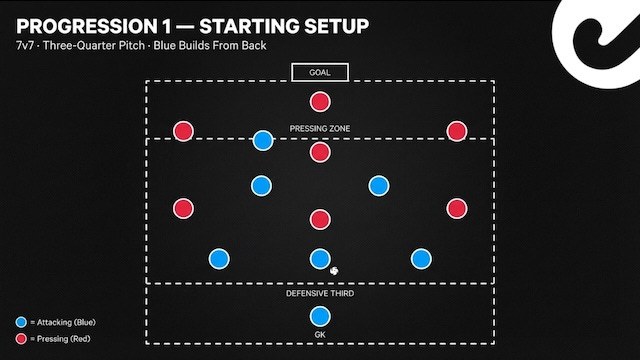
Start with a structured small-sided game that forces the press-break situation repeatedly. Here’s a format that works well:
Play 7v7 or 8v8 on a three-quarter pitch. The attacking team (let’s call them blue) is trying to score in one goal. The defending team (red) sets up in a defined pressing structure—could be your diamond, could be your high press, whatever you usually use.
The key variation: blue starts every possession with the ball in their defensive third, and they must complete three passes before they’re allowed to play forward. This gives red time to set their press. Once blue completes three passes, they can play forward—and they get bonus points for breaking the press cleanly with a single pass that eliminates the first line.
This creates the training environment you need. Red is incentivized to press aggressively (to prevent the clean break), but blue is specifically trying to bypass that press. When the press breaks—and it will, repeatedly—stop play and coach the reset. Where should the delayers be? Are the droppers getting goal-side? Are the deniers closing the gaps?
Run this for 4-5 minute blocks. After each block, show video clips of good and bad resets from that same exercise. The immediate feedback loop is crucial.
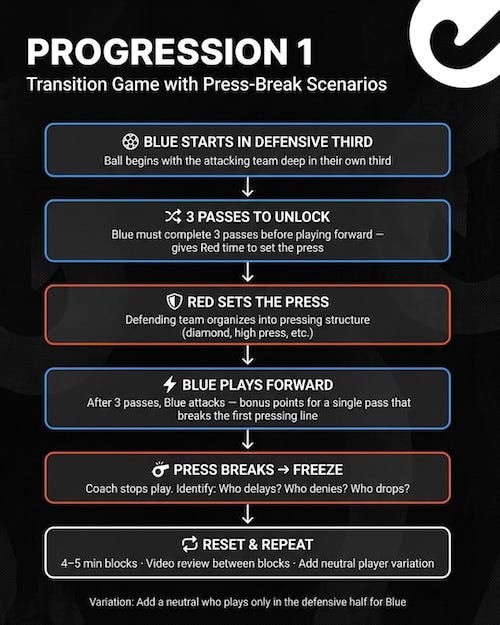
A variation from Tanuscio’s work: add a neutral player who can only play in the defensive half for the attacking team.[2] This creates an automatic outlet for blue when the press comes, which means red has to constantly work on their recovery shape. It mimics the reality of playing against teams who deliberately build with deep outlets to bypass pressure.
The key coaching moments in this game aren’t when the press works—they’re when it breaks. That’s when you blow the whistle, freeze the action, and make sure everyone can articulate their role in that moment. Who should have delayed? Who should have dropped? Did we protect the center? Are the gaps too big?
Progression 2: Match-Play with Constraints
Once your players understand the roles and can execute them in a more controlled environment, you need to test them in something closer to match reality.
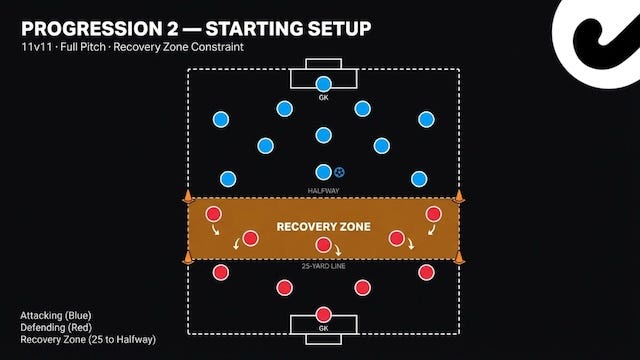
Set up an 11v11 (or 9v9 if numbers are tight) on a full pitch. Play normal hockey with one crucial constraint: every time the defending team’s press is successfully bypassed—and you as the coach are the judge of this—they have to work in a defined zone for the next 10 seconds.
What do I mean by “defined zone”? Mark out an area from the 25-yard line to the halfway line with cones. When the press breaks, the defending team must recover into that zone before they can engage the ball again. This forces them to prioritize dropping and resetting rather than chasing all over the field.
This constraint is artificial, obviously—in a real match, you wouldn’t have a physical boundary. But it’s effective because it makes the reset tangible. Players can’t just mindlessly chase; they have to consciously drop, reorganize, and then engage from a more compact shape.
After 15-20 minutes, remove the constraint and keep playing. You’ll find that the behavior persists even without the physical marker because you’ve trained the instinct to drop first and engage second when the press breaks.
Another variation: play with the condition that the defensive team can only commit a maximum of two fouls outside their own 25 in each 10-minute block. This forces them to be selective about when they press aggressively and when they drop off. It trains that decision-making we talked about earlier—when to re-press and when to reset.
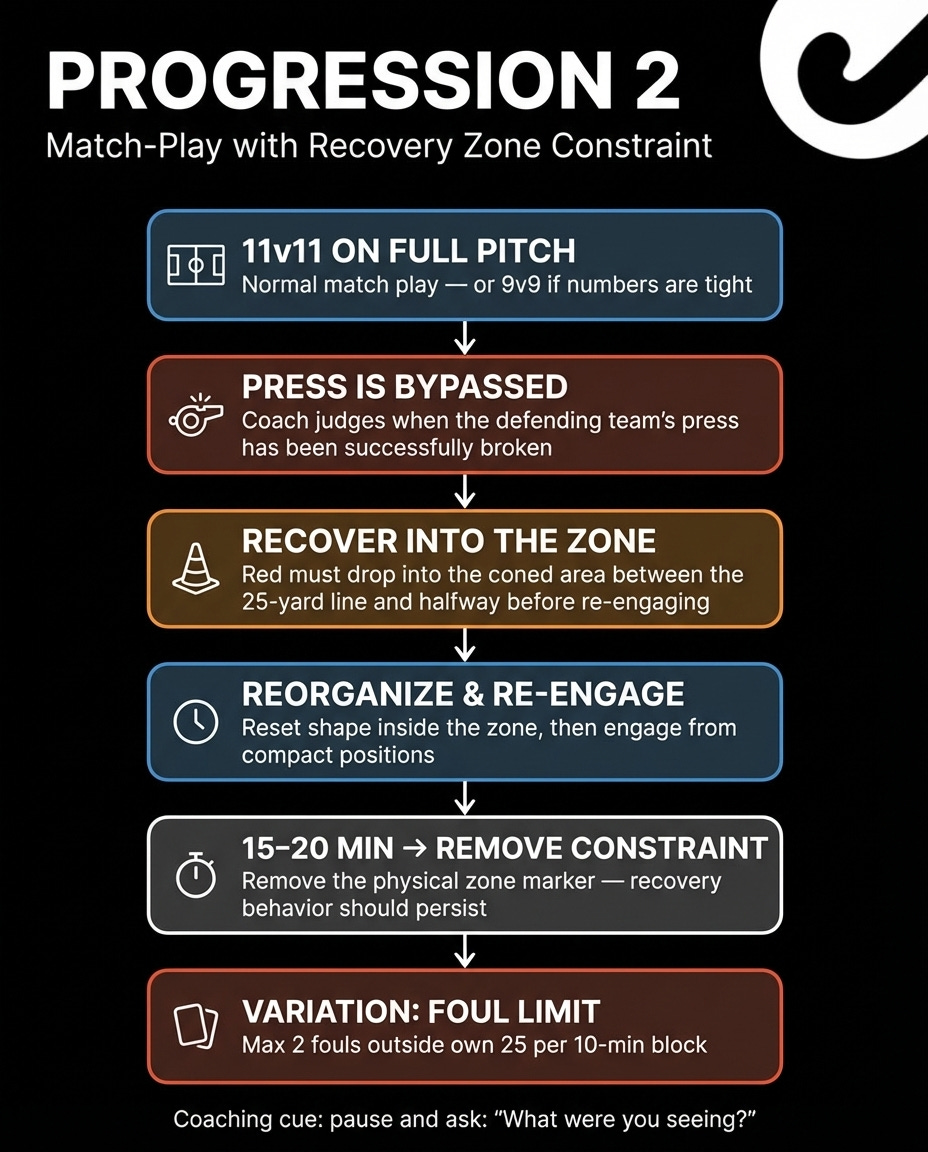
Throughout both progressions, the critical coaching skill is pausing at the right moments and asking the right questions. Not “why did you do that?” but “what were you seeing in that moment?” Not “that was wrong” but “where should you have been and why?” You’re building decision-making capacity, not just drilling movements.
Troubleshooting the Reset: Common Problems and Fixes
Even with good training, things go wrong. Here are the issues I see most often when teams struggle with the reset, along with what’s usually causing them and how to fix it.
