

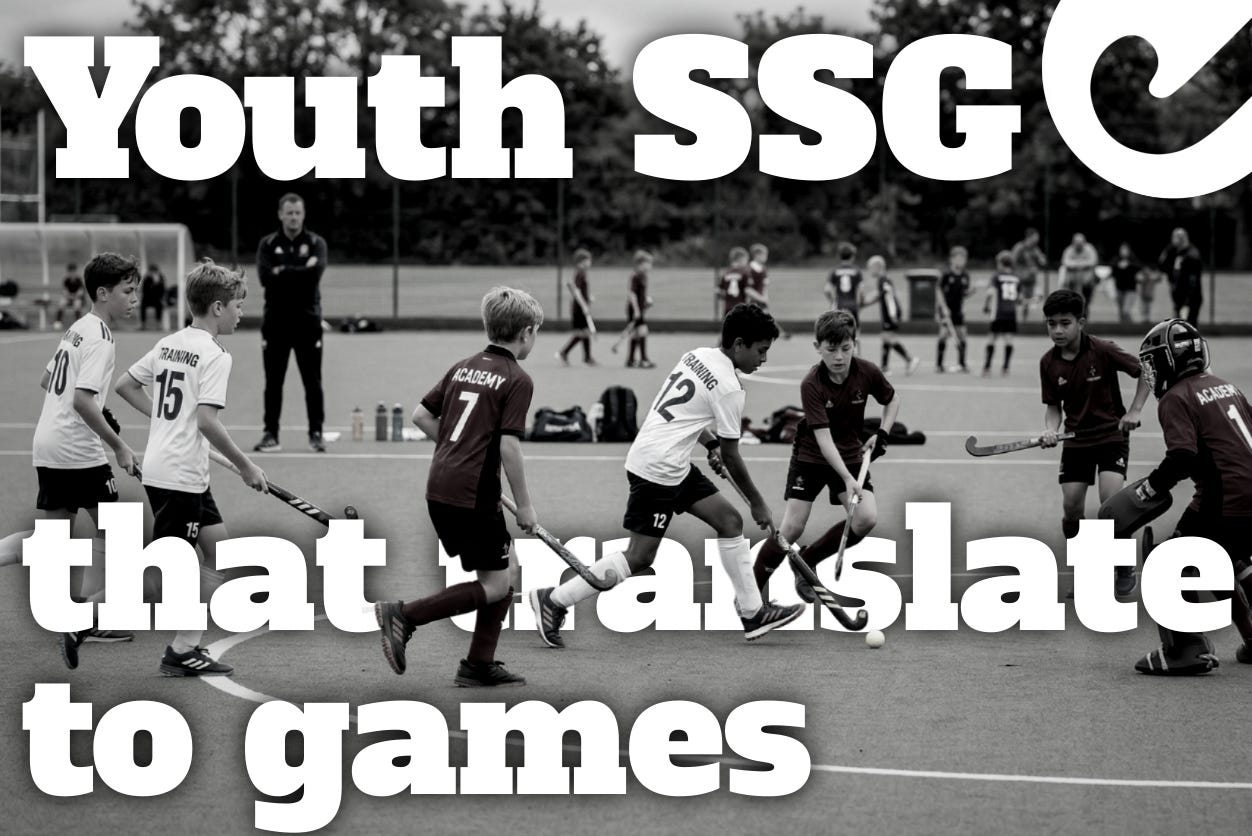
Youth SSG that translate to real games
About small-sided games that actually transfer to match day for youth coaches


Every youth coach runs small-sided games. They’re the bread and butter of a training session; Kids love them, parents see “real hockey,” and you get to stand on the sideline with a whistle feeling like you’ve nailed it. But here’s the thing: most SSGs are just organised chaos with bibs. They keep kids busy. They tick the “game-based” box. But come Saturday, nothing transfers.
Let’s talk about about fixing that. It’s about designing small-sided games with intention! So that what happens in your 4v3 on Wednesday actually shows up in your 8-a-side on the weekend.
We’ll look at what separates a transferable SSG from one that’s just fun, the design variables you can manipulate, and because nobody ever talks about this, when you should not use an SSG at all. Plus two fully worked training examples you can steal and adapt.
Let’s get into it…
TL;DR
Small-sided games only transfer to match day if they’re designed with clear coaching intentions. The magic isn’t in the game itself — it’s in the constraints you set: space, numbers, rules, scoring conditions, and the behaviours those constraints provoke. A well-designed SSG forces players to solve the same problems they’ll face on Saturday. A poorly designed one just makes everyone sweaty. This article walks through the design principles, gives you two ready-to-use examples, and explains when SSGs aren’t the right tool.
This article draws on insights from these coaching voices on The Hockey Site:
Lisa Letchford — Basic Skills through Small Sided Games
Andreu Enrich — Small Sided Games
Tin Matkovic — The Evolution of Creativity & Balancing Skill Gaps
Fede Tanuscio — From Game to Training
What Makes an SSG Transferable (vs Just Fun)
Let’s get real for a second. We’ve all run a 4v4 where kids are smiling, moving, scoring goals — and we think that was a great session. And maybe it was… for fitness and fun. But did it actually teach anything?
Andreu Enrich puts it bluntly: if the game doesn’t force players to solve problems that look like the real game, you’re just running a kickabout with cones. His ecological approach to learning says that players develop by interacting with an environment that demands specific responses. Not by being told what to do — by being placed in situations where the right decision is the only one that works.
So what does “transferable” actually mean? It means the SSG recreates the decision-making context of the match. Not just the physical space, not just the technical demand, but the cognitive load. The moments where a player has to read, decide, and act under pressure.
Here’s a quick test for any SSG you’re running: Can you name the specific game behaviour this SSG is designed to improve? If the answer is “general play” or “getting touches on the ball,” you don’t have a coaching intention. You have a warm-up.
Lisa Letchford’s approach nails this. She starts every SSG with a clear target behaviour — say, receiving on the back foot to create forward momentum — and then builds the game around it. The game isn’t the point. The behaviour is the point. The game is just the vehicle.
And here’s the thing: transferable SSGs don’t always look pretty. Sometimes the game breaks down. Sometimes it’s messy and players make mistakes. That’s not a problem — that’s the learning. As Tin Matkovic reminds us, creativity comes from permission to fail. If your SSG is so structured that there’s only one right answer, you’ve built a drill and put bibs on it.
The Design Variables That Matter
Every SSG is built on the same raw materials. The difference between a good one and a forgettable one is how you manipulate these variables. Think of them as dials on a mixing desk — turn one up, and the whole feel of the game changes.
Space
The most obvious lever, and the one most coaches default to. Smaller space = more pressure, quicker decisions, tighter technique. Bigger space = more time, more running, more scanning required.
