

Attack the Left Foot
Where the stick can't reach: building attacks on the defender's weak side


A common pattern in youth and club hockey: the team builds out the back, the right side flows, but the moment the ball needs to travel through the left or get into the central channel, options dry up. The reverse side looks awkward, the receiving angles look closed, and the players who do try to break through usually end up losing the ball.
This is rarely a problem of effort or talent. It is a problem of where defenders are strong and where attacks tend to live. Many of the defensive techniques in our coaching repertoire, the shave, the jab and the block tackle, work over the ground and apply pressure from the defender’s right side. When the attack stays there, defenders are well-equipped. When the attack crosses to the side where the stick struggles to reach, the defender’s toolkit becomes a narrower set of options.
Several recent The Hockey Site sessions have looked at different parts of this idea: Fede Tanuscio’s left-foot patterns, Russell Coates’s 3D elimination work, Andrew Wilson’s body-open receiving, Simon Letchford’s left-hand grip work, and the defensive grip material from Adam Falla and Ross Gilham-Jones. Each handles a piece of the puzzle. This article puts them next to each other and works through how to use them as one connected attacking pattern.
TL;DR
Defenders are strongest when the ball stays on their right side and on the ground. Attacks that route the ball to the receiver’s body-open side, that exploit the defender’s left foot, or that lift the ball over a horizontal stick make the defender’s standard toolkit less useful. The technical foundations sit in three areas: body shape on the receive, left-hand grip rotation, and the timing of the lift. The article works through what each The Hockey Site source contributes and offers two progressive sessions you can run with U14 and competitive squads.
Sources
Left foot, Fede Tanuscio
How to train 3D elimination skills, Russell Coates
Dynamic receiving, Andrew Wilson
Why the left hand matters, Simon Letchford
Essential grip skills, Adam Falla and Ross Gilham-Jones
Why the left side matters
In Russell Coates’s session on 3D elimination, the standard defensive toolkit in field hockey is a horizontal-stick toolkit. The shave reaches across the ground, the jab pokes the ball away from the carrier’s stick, the block tackle plants flat in front of the ball. Coates puts it directly: the shave, the jab and the block tackle “are basically all utilized in situations where the ball is basically traveling over the ground.”[2]
Adam Falla and Ross Gilham-Jones approach this from the defender’s grip side. Defenders move between two grips during a contest: the frying-pan grip, with the V down the flat side of the stick, for channeling and jab tackles, and the hammer grip, with the knuckles to the sky, for the block tackle. The transition between those two grips, and the speed at which a defender can make it, is a meaningful part of what makes a strong tackler.[5]
This matters because everything in that toolkit assumes the ball stays where the defender’s stick can comfortably arrive. Move the ball into the receiver’s body-open angle, drag the carrier across the defender’s left foot, or take the ball off the ground entirely, and the toolkit becomes a narrower set of options.
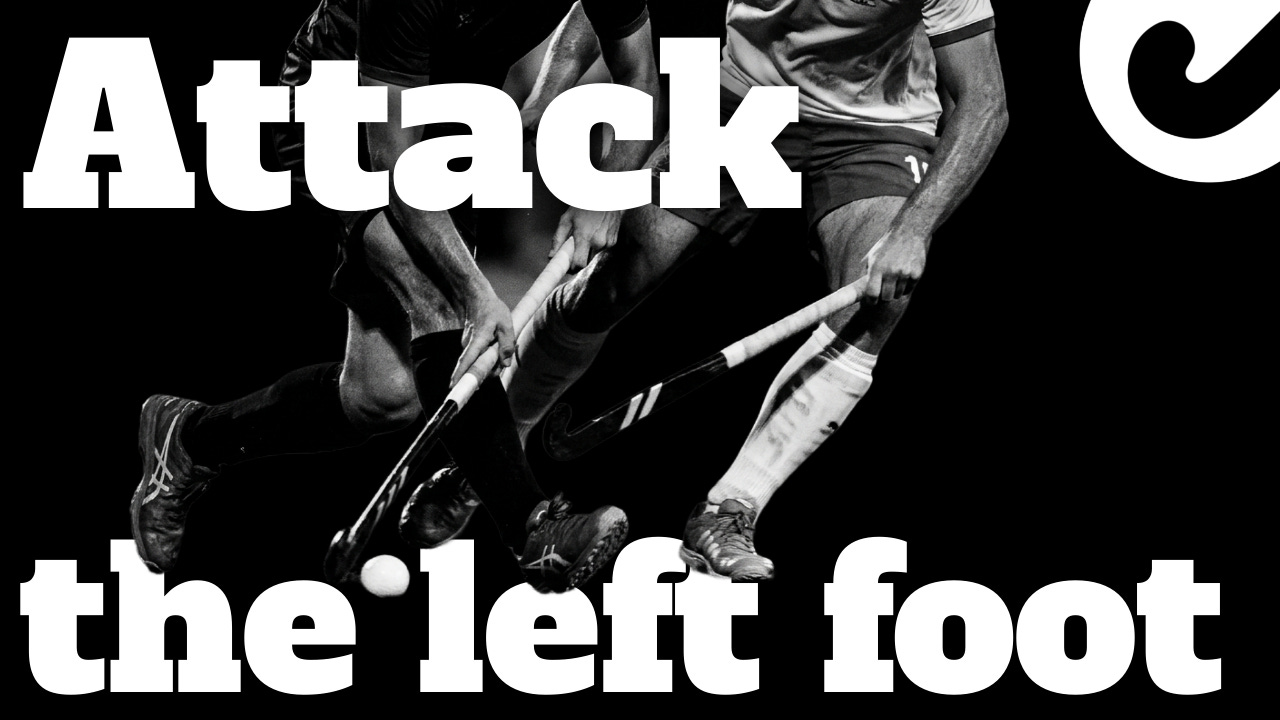
Tanuscio’s left-foot patterns
Fede Tanuscio’s masterclass works through two ways of “playing on the left foot”. The first is a passing pattern: the ball gets played into the receiver’s left foot. Often this involves a contra-lead, a lead against the grain of the play that creates the receiving angle. Tanuscio describes the pattern as leading “with the defender or the strike or midfielder to receive the ball” and then playing the ball “on the left foot of the midfielder.”[1]
The reasoning is body geometry. When the ball arrives on the receiver’s left foot with the body already turning open, the receiver is in a position to play forward, sideways or back without a major reset. The defender, marking from behind, has the stick reaching for a ball that has crossed in front of the receiver’s body. Tanuscio calls this “a vulnerable zone” because the defenders “don’t have any more control of the action.”[1]
The second pattern is the carrying version: the attacker takes the ball into the defender’s left foot. Tanuscio is explicit about this: “What I would like to do it is also attack the left foot with the ball. So dribble the defender on the left foot.”[1] Same geometry, different direction. The ball ends up on the side where the defender’s stick is hardest to bring to bear, and the contest tilts.
Tanuscio places these patterns in different areas of the field. The contra-lead is what makes the angle work in tight central spaces, while in lateral build the receiver’s left foot pattern reads as an outlet that is harder to press.
The receiving foundation
Andrew Wilson’s session on dynamic receiving is the technical floor for everything in Tanuscio’s idea. If the receiver is not turned at the moment the ball arrives, the body-open advantage disappears.
Wilson’s central cue is short: “feet facing where you want to play.”[3] The footwork has to be done early, before the ball arrives, so that the first touch is into the next action rather than into a turn. As Wilson puts it, “move your feet early to get into the position that you want to play into. So if you’re going to receive open, they need to be at least facing the sideline. And then as you touch that ball onto your stick, then they’re fully open in a direction you want to.”[3]
Wilson splits scanning into two pre-receipt actions: a pre-scan that identifies the space and the threats, and a confirmation scan that checks whether the picture has changed. Both happen before the ball arrives.[3] The first touch then has to do less work because the decision has already been made.
Two practical cues from Wilson sit on top of this:
Pass the ball wider than you think. If the pass is too close to the body, even a clean receive ends up on the defender’s strong side.[3] Against a 1v1 press, the lead starts on one side of the defender so the ball can be received in the far space.
The static receive invites pressure. Wilson’s wording: “if we’re receiving statically, especially with a player behind us, it’s just an invitation to be tackled or to be pressed.”[3]
Without these foundations, the receiver’s left foot can be the right destination for the pass and the defender will still win the ball. The body has to arrive turned.
