

Building up against a low zonal block
About understanding the defensive structure, the solutions to break it and knowing how to train these for field hockey coaches


Building up against a low zonal block demands structural sophistication, tactical patience, and relentless training of specific patterns. The most effective approach combines a back-five structure to create 2v1 overloads, systematic use of third-man combinations and give-and-goes to break compact lines, and targeted exploitation of the system’s weaknesses—particularly top corners and flick opportunities around the circle. Success requires drilling these principles through progressive, game-realistic sessions that embed decision-making under pressure.
The low zonal block has become one of modern field hockey’s most effective defensive systems, adopted by elite teams from the Olympics to domestic league top clubs. For coaches building attacking play, it presents a fascinating tactical puzzle: how do you break down a compact, organized defensive structure that sits deep, closes central channels, and forces teams into low-quality shooting positions?
According to Fede Tanuscio, who has analyzed this system extensively at international level, “The low zonal block is a defensive strategy where the team is organized in your own quarter, defending in zones with a low compact shape. The main goal of this system is to reduce the space, protect the scoring area and force the opponent teams into errors and recoverable in safety areas.”[1]
When Tanuscio analyzed six games from the EuroHockey Championships in 2025 featuring low zonal blocks, the statistics were sobering. Teams managed between 8-16 circle penetrations but converted these into only 1-4 penalty corners. “Even if you enter the circle, it’s difficult to get outcomes,” Tanuscio explains. “That’s why we need to work on how we can break down that system.”[1]
For experienced coaches, this article breaks down the structural, tactical, and training principles required to systematically dismantle low zonal blocks.
The Hockey Site hosted these earlier masterclasses and workshops which were the sources for this article.
Low Zonal Block: Advantages, Weaknesses and Practical Exercises

If you’re looking to sharpen your defensive acumen and stay ahead of tactical trends, you won’t want to miss what went down in our latest masterclass with Fede Tanuscio from Argentina. Fede is a familiar face in these sessions (and for good reason!), and this time he took us deep into the world of the
Mastering Third Man Combinations in Field Hockey

In our recent workshop, we delved deep into the concept of third man combinations in field hockey, focusing on how they can effectively break down zonal defenses. Third man combinations have gained popularity in our sport, drawing inspiration from tactical football geniuses like Johan Cruyff and Pep Guardiola. Their use of triangles for possession and creating scoring opportunities is something we can all learn from.
From Game Scenarios to Field Hockey Training: Man-to-Man, Long Corners & More with Fede Tanuscio

What happens when you take real-game challenges and turn them into sharp, game-changing training sessions? If you joined us live for this workshop, you already know: A whole lot of practical insights, field-tested drills, and lively debate! If not—or if you want a recap—read on…
Understanding the Defensive Structure You’re Facing
Before building your attacking approach, understand what the low zonal block is designed to do. The system typically features three to four defenders sitting on or just outside the circle, midfielders positioned in a compact line across the 23-meter area, and strikers whose primary job is to protect the center and block inside passes—similar to indoor hockey principles.
The compact shape achieves several defensive objectives simultaneously. First, it dramatically reduces space between defensive lines, making vertical penetration difficult. Second, it invites teams to play around the structure rather than through it, extending possession time and increasing error probability. Third, it allows defenders to maintain numerical superiority around the circle, with multiple players positioned to intercept crosses and deflections.
As Russell Coates notes when discussing breaking down zonal defenses: “I’ve noticed a trend that quite a lot of teams have adopted a zonal defense and it sometimes can be quite hard to break through the defensive structure.”[2] The key word here is “structure”—you’re not beating individual defenders, you’re dismantling an organized system.
The Structural Solution: Back Five with Purposeful Width
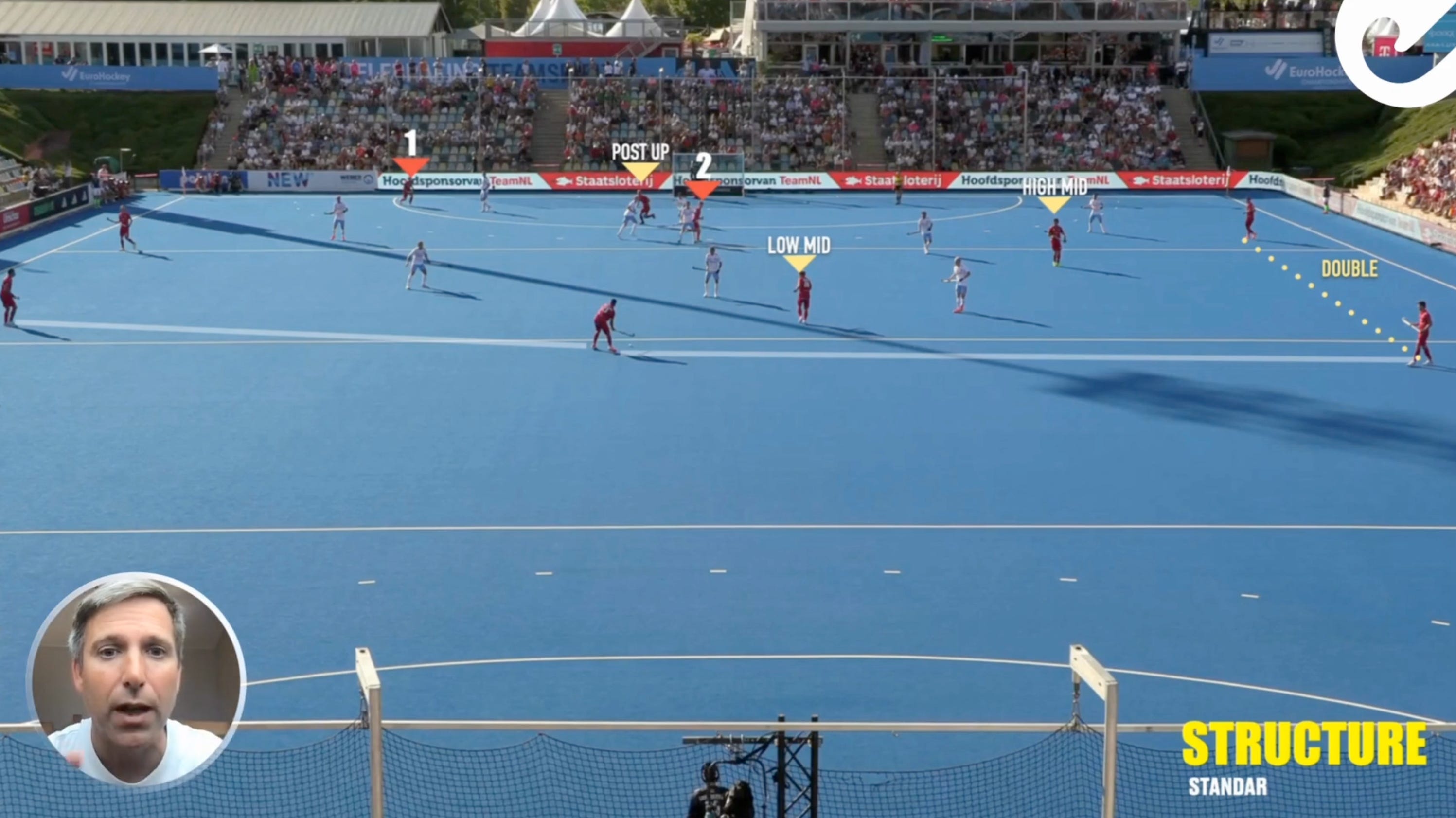
The first principle for building up against a low zonal block is structural. Tanuscio is emphatic: “The normal is to play like a back five situation with a low mid always and a high mid in that position.”[1]
Why back five? The answer is mathematical and spatial. “All we want with the back five is to have double width,” Tanuscio explains. “What do we want with double width is to create 2v1s. That’s what we want to do it. That’s why the standard structure is playing with back five at the back.”[1]
This isn’t simply about having more defenders available. The back five creates consistent opportunities for numerical overloads on the flanks. When the ball is circulated wide, the fullback has two potential passing options in proximity—the wide midfielder ahead and the central defender inside—while the opposing fullback or striker has to make a decision about which passing lane to block. This systematic 2v1 situation is the foundation for breaking compact defenses.
The spacing must be intentional. Your central defenders should be positioned slightly narrower than typical, which seems counterintuitive but serves a crucial purpose. As Tanuscio explains: “Those defenders, the idea of the back five is to find the vertical channels. So if you have the central side defenders, it should be more narrow. And then you can manipulate to play vertical balls, and also the side mids are coming a little bit as back defenders.”[3]
Your three strikers should position inside or just outside the circle to create “post up” opportunities—receiving the ball vertically with their back to goal, then combining quickly to penetrate the defensive line. This forward positioning pins the deepest defenders and creates the space between lines that your midfielders will exploit.
The Tactical Patterns That Break the Block
Structure alone won’t break a well-organized low block. You need specific, trained patterns that systematically create problems for the defensive organization.
Third-Man Combinations
The third-man run is your most potent weapon against zonal defending. As Coates describes: “We’ve been working on third man combinations in buildup and also third man combinations in attacking through a striker that does a post up run to break down defensive lines.”[2]
The principle is simple but devastating when executed well. The ball goes from player A to player B, but player C—the “third man” who is not directly involved in the initial pass—makes a run into space that defenders haven’t tracked because they’re ball-watching. This creates clean penetration through defensive lines.
In build-up, this often looks like: fullback to center-back, center-back to dropping midfielder, midfielder plays the third-man pass to the opposite fullback who has pushed forward unnoticed. The key is that “defenders naturally have more awareness for where the ball is and the player that’s going to receive the ball,” as Coates notes. “In Holland we call that ball watching. And that often frees up space for the third man.”[2]
Give-and-Go Patterns
Against compact defenses, the give-and-go becomes essential, particularly from wide positions. Tanuscio’s analysis of international matches revealed this pattern repeatedly: “I see often... balls out to the wide area. That’s a really important point... give and go, one-touch passes. I see many teams who start to do this.”[2]
The effectiveness comes from the speed of execution. One-touch combinations reduce the defensive team’s time to adjust their compact shape. When your wide forward receives and immediately plays back to the advancing midfielder, then continues their run forward to receive again, the zonal block struggles to maintain its structural integrity.
As Tanuscio emphasizes, this requires specific positioning: “The striker, where is the striker? In which position is the striker ready to receive the ball in that spot to be a one and then direct ball to the circle.”[2] Your strikers must position at the low part of the circle, ready to combine in one or two touches maximum.
Manipulating the Midfield Line
The compact zonal block relies on its midfield line maintaining discipline and proper spacing. Your job is to manipulate this line through intelligent movement and passing sequences.
According to Tanuscio, one effective approach is to deliberately narrow the defensive structure before exploiting width: “Instead of passing the ball directly wide and their striker being able to run and close off the passing line, we want to use a midfielder to really narrow them in shape because he’s now attracted three of their players, then opens through the pocket of space, passes the ball out wide.”[2]
This creates time on the ball for your wide players. Rather than receiving under immediate pressure, they have space to lift their head, assess options, and make quality decisions.
Exploiting Systemic Weaknesses
Every defensive system has inherent vulnerabilities. The low zonal block’s weaknesses are predictable and exploitable if you train them systematically.
Top Corners Are Critical
“For me, top corners—that’s for me the most important one,” Tanuscio states emphatically about the system’s primary weakness.[1]
The top corners of the circle (the areas at roughly 45 degrees from each goal post) become danger zones because defenders must make a critical decision: stay compact in the circle or push out to pressure the ball. When the ball arrives at the top corner with time, defenders need to sprint out to create numerical superiority and prevent crosses.
But this is also where teams defending the low block are most vulnerable. “If you see well, we have much more numbers, not possible to cross the ball. Everybody’s in good position. They have 1, 2, 3, 4, 5 guys ready to intercept,” Tanuscio explains when showing proper defensive coverage. But when this doesn’t happen quickly enough, the attacking team gets clean crossing opportunities.[1]
Train your wide players to recognize when they have time at the top corners. Rather than rushing crosses, they should draw defenders out, creating space inside for deflections or one-touch finishes.
Flicks Around the Circle
“Another weakness of the system are the flicks—the flicks at the top corners are rounded. Flicks around the D can be very tricky,” notes Tanuscio. “We are waiting more for flicks inside the D than the flicks around the D. So that’s something that can be one of the points.”[1]
Low zonal blocks position defenders to defend flicks from inside the circle, where they can use their bodies to block or where the goalkeeper has better angles. Flicks from just outside the circle or from wide angles are geometrically more difficult to defend because defenders can’t risk giving away corners by attempting to block with their body, and goalkeepers have poor angles for aerials from these positions.
Training Methodology: From Principle to Pressure
Understanding the principles is insufficient. Your training sessions must systematically develop these patterns under increasing pressure until they become automatic in match situations.
Progressive Drill Design
Tanuscio’s approach to training against low zonal blocks follows a clear progression: isolated technical work, then semi-opposed scenarios, then full game situations with specific constraints.
Phase 1: Technical Fundamentals (10-15 minutes)
Start with unopposed work on the specific patterns. For give-and-goes, set up simple circuits where players practice the timing and weight of the return pass. For third-man combinations, create drills where three players practice the sequence: A to B, B to A, A to C who has made a penetrating run.
The focus here is purely mechanical—getting the technical execution smooth before adding defensive pressure. As Tanuscio puts it: “Give and goes—that’s something very difficult to defend in a small zone.”[1] But only if executed cleanly.
Phase 2: Opposed Patterns (15-20 minutes)
Now add defenders to create decision-making pressure. A particularly effective drill structure Tanuscuo uses: set up a baseline scenario on the right side as 2v2. “We’re going to start with a two against two. Pass, pass back. And the idea here is really just get into the circle. Post-up players receiving every time... asking give and goes to get into the circle.”[2]
The constraint is critical: players can only enter the circle via give-and-go combinations or through the third man. This forces the pattern while maintaining game-realistic pressure. Rotate sides—left-foot combinations on the left, give-and-goes on the right, central deflections through the middle.
Phase 3: Game Simulation (20-25 minutes)
The final progression must replicate match conditions. Tanuscio recommends splitting the field into thirds with specific rules: “From the left is give and goes, and from the right is give and goes... everything we were working before. Give and go, third players and post up players. So everything is in a normal game now situation.”[2]
This constrained game maintains the tactical focus while allowing for the chaos and adaptation of real match play. The constraints act as “rules of engagement” that reinforce the patterns without making the game feel artificial.
Creating Realistic Pressure
A crucial training principle when working against defensive systems: always train in numerical equality or disadvantage. Tanuscio is clear about this: “I like to work on this goal-scoring exercise always being under-low situation. That brings us to reality. It’s really difficult to see scenarios where we are more than the defenders when we’re attacking.”[2]
If you’re training 4v3 attacks and celebrating success, you’re not preparing for the reality of facing a low zonal block, which by definition creates numerical equality or defensive overloads around the circle. Train 3v3, 4v4, or even 3v4 scenarios to force players to solve problems through quality execution rather than simply outnumbering defenders.
Common Training Mistakes to Avoid
The most common error coaches make when training against low blocks is focusing too heavily on set patterns without developing decision-making. Your players must be able to recognize when to use third-man runs versus when to play more direct, when to slow the tempo to manipulate the block versus when to speed up and catch the defense in transition.
Another mistake is training these principles only in build-up zones. The same principles apply when entering the 23-meter area and particularly around the circle. Your strikers need repetitions of post-up play under pressure, your midfielders need practice delivering the ball to feet in tight spaces, and your wide players need countless repetitions reading when they have time at the top corners versus when they need to play quickly.
Finally, avoid training these patterns only against passive or semi-passive defenders. As Tanuscio notes in his general coaching philosophy: “Sometimes some trainers, they were not deciding the training. So make a training just to make a training.”[3] Be intentional. If you’re training to break low blocks, set up genuine low block defensive structures and have them defend properly. Otherwise, you’re not preparing for the tactical reality your team will face.
The Mental Game: Patience and Decision-Making
Perhaps the most underrated aspect of playing against low zonal blocks is the psychological dimension. These systems are designed to frustrate, to force errors through impatience, to make teams rush decisions because they’re struggling to penetrate.
Your players must understand that possession itself is valuable when facing a low block. Sometimes the third-man combination isn’t available. Sometimes the give-and-go is blocked. In those moments, circulating the ball back through your defensive structure and trying again from a different angle is not a failure—it’s tactical intelligence.
Train this patience in your sessions. Don’t allow players to force passes that aren’t on. Celebrate the decision to keep the ball and reset as much as you celebrate successful penetration. Over a 60-minute match, the team that maintains composure and waits for genuine opportunities will create far more chances than the team that forces low-percentage passes out of frustration.
Three Coaching Takeaways to Implement Tomorrow
1. Install the Back-Five Structure with Purpose
Tomorrow’s training session: run a 20-minute possession game where your team must build up using a back-five structure. The rule: to enter the attacking half, you must create and use a 2v1 overload on one side of the pitch. This ingrains both the structural principle and the tactical objective simultaneously. Don’t just tell players to “play back five”—give them a clear problem to solve that requires exploiting the numerical advantages this structure creates.
2. Constraint-Based Give-and-Go Training
Set up a 4v4 game in a 30m x 20m area with two small goals. The constraint: teams can only score within 10 seconds of completing a successful give-and-go combination. This forces players to actively seek these patterns while maintaining game realism. Run this for 15 minutes, coaching the timing and weight of return passes in the moment. Players will quickly internalize that give-and-goes create the space needed to penetrate compact defenses.
3. Top Corner Finishing Circuit
Create a rapid-fire finishing drill focused exclusively on the top corners of the circle. Set up two feeding stations at each top corner. Attackers receive at the top corner, have 2-3 seconds to decide: cross low for a deflection, flick around the D, or attack the circle edge for a direct shot. Rotate through 3-minute cycles. This builds both the technical skill and decision-making speed required to exploit this critical weakness. Key coaching point: when you have time at the top corner, make defenders come to you—don’t rush the decision.
The low zonal block is a sophisticated defensive system, but it’s not impenetrable. With clear structural principles, trained tactical patterns, and progressive, game-realistic training methodology, you can systematically develop your team’s capacity to break it down. The difference between good teams and great teams isn’t just understanding what to do—it’s drilling it until execution under pressure becomes automatic.