

Can Someone Please Think About Goalkeepers? 
A reflection on how we think about and train goalkeepers. 


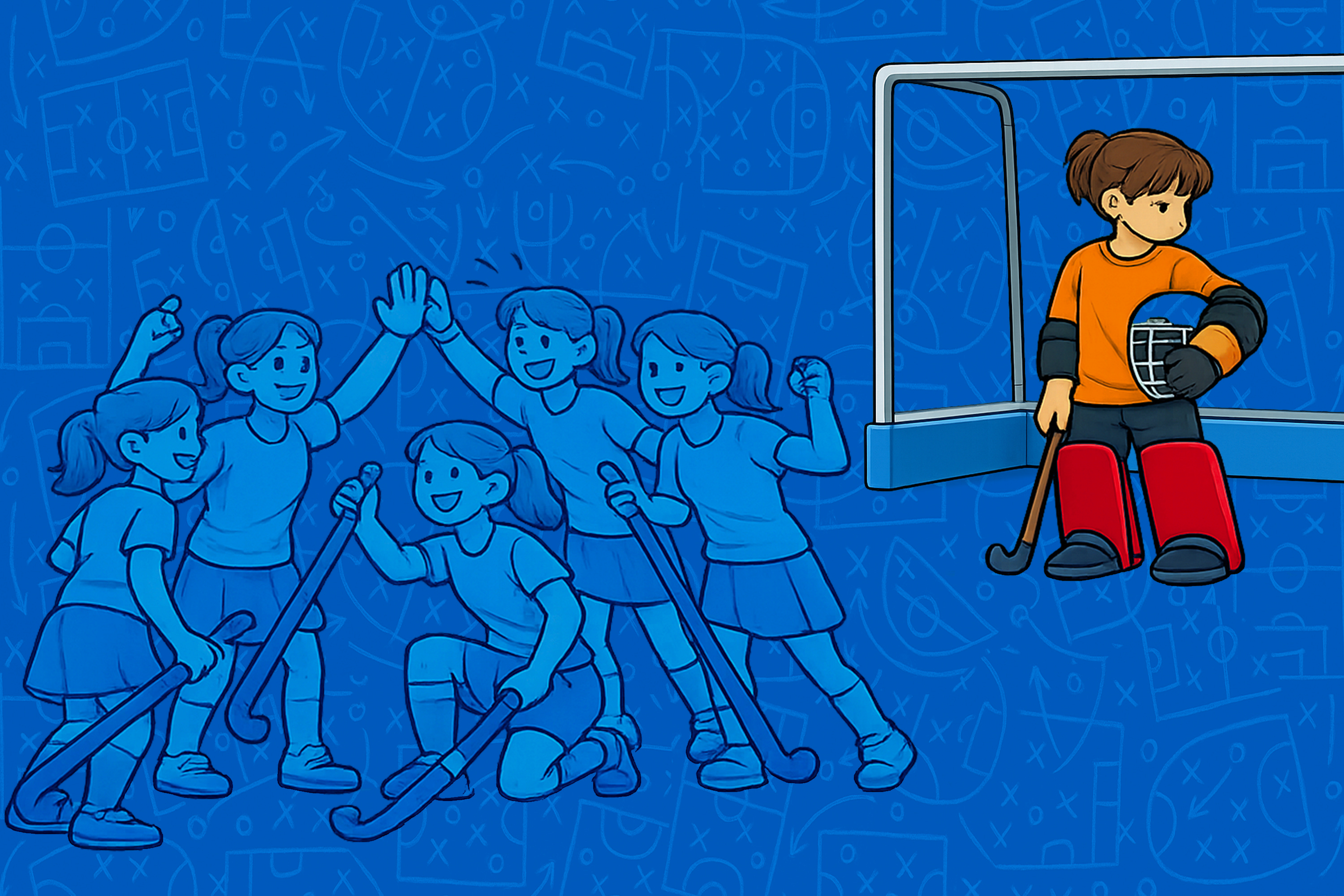
Goalkeepers are, by definition, the only players on the team who are truly different. They can kick the ball, they dress differently, they use a different stick… they have little in common with the rest. Many times even their personality is different. And we have to admit it: not everyone is cut out to stand in the goal and have balls smashed at them.
If from the start there are so many factors that separate them from the rest, many times we as coaches don’t help them integrate either.
A very common scene in any training session is seeing the coach together with the players talking, explaining the drill and the objectives, while the goalkeeper is alone in the goal. They listen from afar. They only half understand. They arrive late to the main idea. During the drill, they’re simply there so that the players feel a challenge when they shoot on goal. But for the goalkeeper, it doesn’t always give them very much. We don’t design trainings thinking also about their development.
Not to mention the fact that in matches we expect them to have a leadership role, organizing the defense, correcting, directing. How can we expect leadership from someone who we leave on the sidelines all week?
This might happen because they have their own goalkeeper coach, in those clubs lucky enough to have that. It also happens because, as coaches who were never goalkeepers ourselves, we feel we don’t have the tools we need to help them.
The aim of this episode is to show that this idea is far from reality and that, with very little, we can help them a lot. But for that we first have to accept our responsibility.
Start with the simplest things
The first thing we need to understand is that training with the team, for them, is not only about technical work. It’s also about feeling part of the group.
We need to help them integrate, to make sure they’re not off to the side but inside the dynamic of the group. And that is often built through small details: waiting until they’re in the circle before starting, including them in the talks where we explain the objectives, asking for their opinion.
During training we have to talk to them. They need to know that we pay attention to them just as much as to the others. Sometimes a correction, a question, or even a simple encouragement is enough.
Thinking about them in the plan
If we go a bit more into the technical side, as we said before, in the vast majority of training sessions we simply put them in the goal to face shots. Or worse: they’re there, standing, and touch a ball every fifteen minutes.
When we sit down to plan, we have to think about them.
– Will they have activity in this drill?
If the answer is no, then we need to change something. There are many ways to do it:
Add extra balls with different types of shots.
Play in an uncomfortable ball for them so there’s a rebound and the game continues from there.
If it’s a possession game without a shot on goal, use the goalkeeper as a defender, moving and participating with the team. In fact, this is very useful for the attackers, since the goalkeeper, being allowed to kick the ball, forces them to play outside their radius of action.
These are just a few ideas. The specific adjustment is not so important; what matters is that we start thinking about them and asking ourselves what participation they will have.
– Is the game situation they will encounter realistic?
And what about the level of danger?
Another very common situation is creating drills where it ends up four attackers versus the goalkeeper hitting from five meters. Even though they have protection, those shots hurt. And if the situation is not realistic, not only does it not help them, it also frustrates them.
Sometimes something simple is enough: limiting the zones from which you can hit, adjusting distances or the rules of the drill.
– Will they have sufficient pause/rest?
Sometimes there are so many consecutive shots or attacks that they end up exhausted. And that can become dangerous if they don’t have enough reaction speed.
If this happens and we only have one goalkeeper, we have to give them the freedom to manage their own pause: step out of the goal, recover and come back when they feel ready, even if that affects the drill for the field players.
This is also a way to recognize them and make them feel that they are just as important.
Their role within the team
As I said earlier, during some trainings they don’t have much activity. And that isn’t necessarily something bad, as long as we give them clear objectives to work on.
The goalkeeper, within the team, has the fundamental role of organizing.
We can have a drill where they don’t touch the ball, but they still have a clear objective in terms of communication. Design a task where they’re the only person allowed to speak and say which player is free, or where they have to organize the defense but are not allowed to make saves.
These are only a few ideas; the important thing is to understand this: we are not developing that ability enough. And something key: leadership doesn’t magically appear on the weekend; it’s trained during the week.
Educating ourselves is also a way to respect them
Almost everything we’ve talked about so far are tools that we have within reach so that, with little effort, we can help them.
Having said all this, I don’t want to fail to mention that, even if we were never goalkeepers, this is not an excuse for not learning some technical details and adding tools to support them.
There’s no need to go to a specialist goalkeeper course; it’s enough to approach any coach, or an adult goalkeeper, and ask them for some basic notions: correct posture, a few tips, anything.
Personally, I was lucky enough to work with great goalkeeper coaches, from whom I learned a lot, and today I feel that at least I have the basic tools to make some technical corrections.
If you’re interested, at some point we can put together an episode with a goalkeeper coach to share these basic concepts.
Much more than just making saves
We ask them to make saves.
To organize.
To hold the team together.
But we also want them to enjoy it.
To feel part of the group.
To grow in the role they chose.
None of that happens by magic.
It’s built when we integrate them, when we think about them in our planning, and when we educate ourselves so we can support them.
After all, it’s not just about improving the goalkeeper.
It’s about taking care of the person under the helmet.
What’s next
For the moment I’ve chosen not to have a formal job. My goal is to work with more flexibility so I can organize my time freely. To keep putting a lot into online content and also offer consultancy and talks in clubs. If anyone is interested, don’t hesitate to write to me.
See you next time!
Javi
Need to see some more on goalkeepers?
Consider these ↓
How to train your goalkeeper

All of us know Pirmin Blaak to be this outstanding goalie himself. But several years ago he also co-founded Goalieworks.com to improve training for hockey goalies. Today his academy is active on several locations in the Netherlands and training +800 keepers every week.
Junior Goalkeeper Development

Mili Arrotea wil host a series of 3 masterclasses for GK training. The first one was live on November 10, 2023 with a focus on junior goalkeeper development.
GK development for U18 & Senior

Mili Arrotea will host a series of 3 masterclasses for Goalie Development. The first one was live on November 10, 2023 and focussed on junior goalkeeper development. This one, live in 2024 on Friday January 26, is the 2nd in the series of 3 and its focus is on U18 & Seniors.
Training High Performance Goalkeepers

Mili Arrotea hosts a series of 3 masterclasses for Goalie Development. The first one was live on November 10, 2023 and focussed on junior goalkeeper development.
 | A guest post by
|