

Coach Less. Teach More.
Stop explaining. Start designing. A practical guide to constraints-led coaching, with the scoring trick that does the work for you.


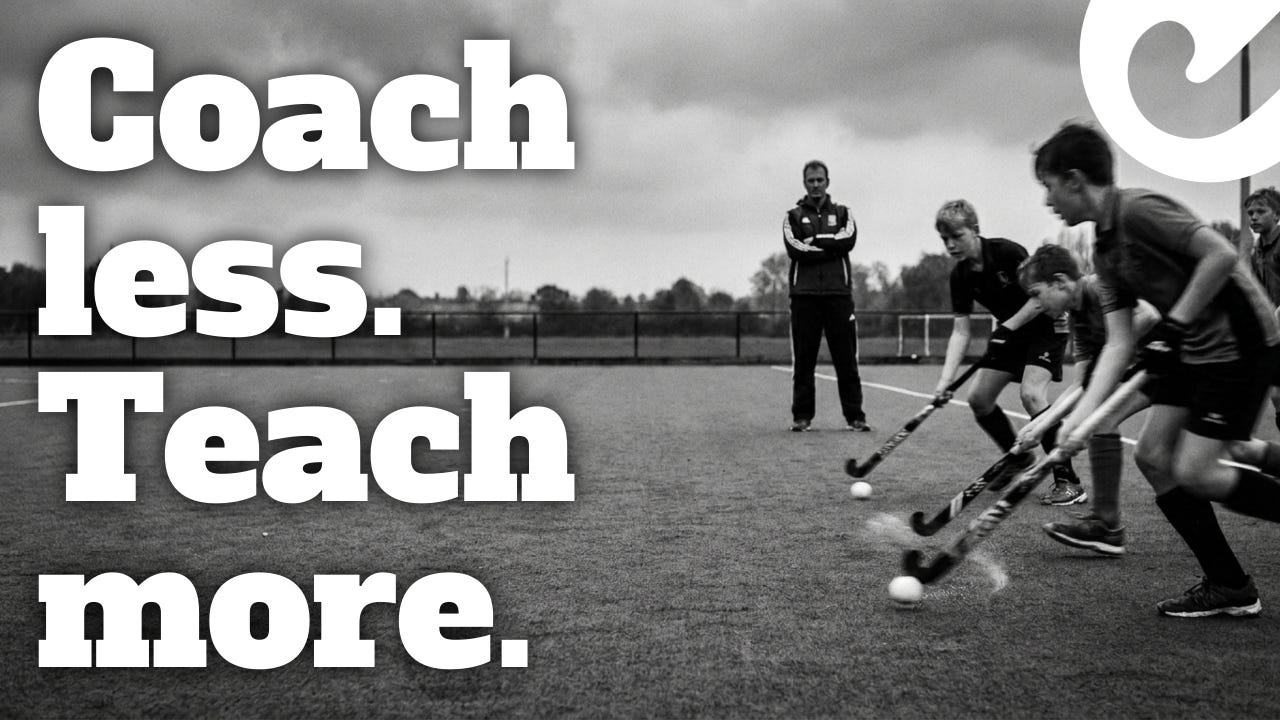
We all know the coach. Maybe at some point we have all been the coach. The one who blows the whistle every ninety seconds. Who stops a 4v3 the moment a pass goes astray, gathers the players in, draws something on a whiteboard, makes a long point about angles and timing, then sends them back to play for another forty seconds before stopping it again. By the end of the session that coach has talked a lot. The players have played maybe twelve minutes of actual hockey out of sixty. And on Saturday morning, when the same situation comes up in a real match, they look around for someone to tell them what to do.
Here is the awkward bit. That coach is not teaching more by coaching more. They are teaching less. Players are quietly being trained to wait, to defer, to check in with the adult before acting. Then we wonder why our youth players freeze the first time the press comes hard, or why they cannot improvise when a pre-rehearsed pattern breaks down.
What if the answer is the opposite of what most of us were handed as players? What if, to teach more, you have to coach less? You can design practices that teach without you saying a word. The pitch becomes the teacher. The rules become the teacher. The scoring conditions do the coaching for you. You stand on the side, you watch, you ask one good question at the end, and the players walk off the pitch having learned more than they would have from a half-hour lecture. That is the constraints-led approach in a sentence. The rest of this article is about how to actually do it.
TL;DR
Most of us were taught that good coaching means good explaining. The longer and clearer the instruction, the better the coach. Constraints-led coaching flips that on its head. Instead of telling players what to do, you design the situation so the right behaviour becomes the obvious answer. You change the size of the pitch, the scoring rules, the number of players, the number of touches, and suddenly the players solve the problem themselves. Below we unpack what the approach actually means in plain English, look at the three types of constraints you can play with (task, environment, player), show how to use scoring conditions to pull behaviour out of players, contrast it with prescriptive coaching, flag the most common mistakes, and finish with three before-and-after redesigns of drills you probably already run.
What the constraints-led approach actually means in plain English
If you read the academic stuff on constraints-led coaching you will quickly drown in talk about ecological dynamics, affordances, perception-action coupling, and self-organising systems. All of that is real and interesting, but for a Tuesday evening youth session it does not help much. Here is the version a coach might explain to a fellow coach in the carpark.
A constraint is anything that limits or shapes what a player can do. The size of the pitch is a constraint. The number of touches you allow is a constraint. The way a goal is scored is a constraint. The number of attackers and defenders is a constraint. So is the rule that the ball has to be received on the move, or that the goalkeeper plays out under pressure, or that you can only score in the last third after three passes. Every drill you have ever run had constraints in it. The question is whether you chose them on purpose or by accident.
Constraints-led coaching is just the deliberate version. You decide what behaviour you want to see on Saturday. You then design constraints that make that behaviour the smartest available option. You put the players in the situation, and they solve it. Not because you told them, but because the rules of the game pointed there. Tin Matkovic, in his masterclass on creative player development, basically said the same thing in different words when he described shifting from “this clarity of everything that’s being done and also having a control” to letting the players “find their own way of doing it.” That shift, from instruction to design, is the whole thing.
The three types of constraints
It helps to break the toolbox into three drawers. This is borrowed from the academic literature, kept as simple as possible here.
Task constraints are the rules of the activity itself. The number of touches. How a goal counts. Whether you can play backwards. How many passes before you can shoot. Whether a tackle restarts the move or wins possession. These are the constraints we usually reach for first because they are the easiest to change. You can layer or strip a task constraint mid-session without moving a single cone.
Environment constraints are the physical and contextual conditions. The size and shape of the pitch. The number and placement of goals. Where you put the bibs. Whether players are wearing wet weather kit on a soaking day or training in a quiet hall in February. The presence of a real goalkeeper versus a target board. Even noise level can be an environment constraint, because real matches are loud and players need to learn to communicate inside that.
Player constraints are about who is on the pitch and in what state. Tall versus short. Skilled versus developing. Fresh versus tired. The numerical balance, three v three plus a floater, four v two plus a goalkeeper. Even pairings matter. If you always put your strongest two together you remove the constraint of having to make weaker teammates look good, and you lose a huge chunk of the learning.
In practice you almost never manipulate just one drawer. A great session pulls one or two levers from each. A 4v4 in a long thin pitch with two-touch on the attackers and only the back four allowed to score is a task plus environment plus player constraint stacked together, and the behaviour it pulls out of players is almost predictable.
Designing scoring conditions that do the coaching for you
This is the bit that, when it clicks for a coach, often leads to rethinking a lot of how sessions get planned. If you want to teach a behaviour, one of the cleanest ways is to coach it less directly. Make it the most profitable thing on the pitch.
Want your players to switch the play more? Make a goal scored after a switch worth three. A goal without a switch worth one. You will not have to say a word. Quite quickly, players start looking up and asking for the ball wide.
Want them to penetrate the circle through combinations rather than individual carries? Make a goal from a one-two inside the D worth double. Want defenders to pressure earlier? Award the defending team a “goal” every time they win the ball back inside ten seconds.
Robert Noall, in his workshop on on-ball decision making, said it really well. He said he is “allergic to pass to the right for five minutes, then to the left for five minutes.” The fix is “open-ended scenarios, even in foundational drills, so players make real choices, not follow a script.” The scoring system is your script. Get it right and the players write the lesson themselves.
This is also, by the way, why the constraint of asymmetric scoring works so well with younger players. With U8 and U10s, Robert advised making “the chance of success laughably high. Six attackers, two defenders, wide spaces, and heaps of positive feedback.” That is a player constraint plus an environment constraint, and it teaches the same thing as a fancier set up would, just with the volume turned right up so the kids can actually hear the lesson.
Prescriptive coaching versus guided discovery
There is a fork in the road every coach stands at multiple times in every session. The ball is loose. The 2v1 is forming. A player hesitates. You can do one of two things.
Option one. You stop play, you tell them what they should have done, you set them up again with a clearer picture of the right answer, you restart. They run the play again, this time correctly. You are happy. They got the answer.
Option two. You let it play out. Maybe the wrong choice gets punished, maybe it does not. At a natural pause you ask one short question. “What did you see?” Or “What other option did you have?” You let them answer. You nod. You let them play on. Maybe next time they choose differently, maybe they do not. The session feels less productive in the moment.
Option one is prescriptive. Option two is guided discovery. What many coaches notice, having tried both with different groups across a season, is that prescriptive coaching gets faster surface results in the short term and tends to leave players more dependent under match pressure. Guided discovery is slower, messier, occasionally infuriating, and tends to produce players who can solve problems on their own.
The constraints-led approach lives squarely on the guided-discovery side, but with one big advantage. You do not have to be a great questioner to make it work. The constraints do most of the questioning for you. The pitch is asking the question. The scoring rule is asking the question. All you have to do is shut up long enough to let the players answer.
Common mistakes when first trying constraint-based design
These are mistakes most coaches make at some point. Here is the cheat sheet that many a coach wishes they had been handed five years earlier.
The first mistake is too many rules at once. You read about constraints, you get excited, and your first session has five layered constraints, two scoring conditions, three pitch zones, and a goalkeeper restart. The players spend the entire warm-up trying to remember the rules, none of the actual hockey emerges, and you go home thinking “well, that was a flop.” One constraint at a time. Stack a second one only when the first is no longer producing the behaviour because players have figured it out.
The second mistake is unclear objectives. If you cannot say in one sentence what behaviour you want to see, you cannot design constraints to pull it out. “I want to work on attacking” is not an objective. “I want my forwards to receive the ball with their first touch going forward” is. The clearer the target, the cleaner the constraint design.
The third mistake is no progression. A constraint is a teaching tool, and once the lesson is learned the tool stops working. If your 3v2 with a two-touch limit is producing nice passing on Tuesday, by next Tuesday it should be 3v2 with one-touch, or 3v2 in a shorter pitch, or 4v3 with a different scoring rule. Static constraints become a comfortable home where players stop being challenged.
The fourth, and the one many coaches keep falling into, is rescuing the session with words. The players are not getting it. The behaviour you wanted is not appearing. Your training brain says “just stop them and explain.” Your constraints brain should say “the constraint is wrong, change the constraint.” If a 4v4 is not producing penetration in the circle, do not lecture them on circle entries. Make the pitch smaller. Add a third defender so the wide overload is more attractive. Award double for goals via a third-man run. Adjust the world, not the words.
Andreu Enrich, in his masterclass on learning environments, made this really clear. Feedback should be “immediate, specific, and contingent.” Three constraints on your own behaviour, basically. If you are talking when it does not meet those three tests, you are noise. Let the constraint do the work.
Training examples: before and after
Three examples that many coaches have run in some form. The “before” versions are not bad sessions. They are the standard sessions most of us were given as players. The “after” versions are simply the same idea with the constraints chosen on purpose.
Example 1. The passing square
Before. Four players in a square, ten metres a side. They pass clockwise for two minutes, then anticlockwise for two minutes, then with one touch, then with two. The coach calls out “good” a few times. The session is tidy, everyone gets touches, and almost nothing transfers to a match.
After. Four players in a square, but now there is a fifth player in the middle who is a real defender, not a passive cone. The four outside players score a point every time they complete five passes without losing it. The defender scores a point every time they touch the ball. After two minutes the defender is replaced by whoever scored fewest passes. The constraint of a live defender plus the scoring rule plus the rotating role does three things at once. Players have to scan before receiving. Players have to play sharp because the defender is hunting. Players have to communicate because the rotation rewards collective performance. You did not say any of those words. The square taught them.
Example 2. Outletting against pressure
Before. A backline of four plus a goalkeeper, two forwards from the opposition press them. The coach calls “go,” the GK plays out, the back four pass it across, find a release, the coach calls “well done” or “do it again with more width.” Repeat for fifteen minutes. The players know what is coming, the forwards barely press because there is no consequence, and the whole thing has the energy of a polite rehearsal.
After. Same setup, two changes. First, if the press wins the ball inside the defending half, the press counter-attacks for ten seconds and any goal scored is worth three. Second, if the back four successfully play the ball into a marked midfield zone, that is one point, but if they do it through a third-man combination it is two. Now the press has a reason to press hard. The back four have a reason to look for combinations rather than safe sideways passes. Fede Tanuscio, in his masterclass on going from game to training, talked about exactly this kind of layered scoring as the way to bridge the gap between video analysis and pragmatic training sessions. The coach barely speaks. The constraints are speaking instead.
Example 3. The 1v1 line drill
Before. Cones in a line. One attacker, one defender, ten metres apart. Attacker tries to beat the defender to a goal at the end. Coach watches, gives technical feedback on the dummy, the elimination, the body position. Decent for technique. Borderline useless for actual game-like elimination because real 1v1s never start ten metres apart in a clean line.
After. A grid of fifteen by twenty metres. Three attackers and three defenders queue at opposite ends. A coach feeds a ball into the middle. Whichever attacker gets to it first goes 1v1, but the chasing defender from the same end can recover. A goal is worth one. A goal scored after the attacker has eliminated the first defender with a change of direction is worth two. A goal scored within five seconds is worth three. Now you have time pressure, recovery defenders, real perception, and a scoring rule that rewards exactly the kind of dynamic 1v1 that shows up in matches. This example is put together in the spirit of Robert Noall’s 1v1 work, where he insists on full-speed 1v1s with no predetermined moves and on game-like scenarios over isolated drills. The contrast with the line-cone version many coaches grew up with is significant.
Three takeaways
One. Decide what you want to see, then design for it. Behaviour first, constraint second. If you cannot say the target behaviour in one short sentence, do not start drawing cones yet. A lot of bad constraints come from skipping this step.
Two. Trust the design and shut up. Every time you feel the urge to stop the play and explain, pause for a beat. Ask yourself, is the constraint wrong, or am I just nervous about the silence? If the constraint is wrong, change it. If the silence is the problem, sit in it. Players learn in the silence. They cannot learn in your monologue.
Three. One lever at a time. Constraints are not seasoning to be sprinkled. They are tools to be wielded. Add one. Watch what happens. Adjust. Add another only when the first is doing its job. The most boring, most disciplined, most repeated versions of constraints-led coaching are also the ones that produce the best players. Short, simple, repetitive, as the half-time NBA piece reminds us. Embrace the boring fundamentals of design and the players will do the spectacular stuff for you.
Sources
About Feedback, Anchor Tasks, Managing Arousal and so much more
Practical Approaches for Fostering Creative Field Hockey Players
From Game Scenarios to Field Hockey Training: Man-to-Man, Long Corners & More with Fede Tanuscio
Excellent what a great help.