

When to Stop Coaching and Let Them Play
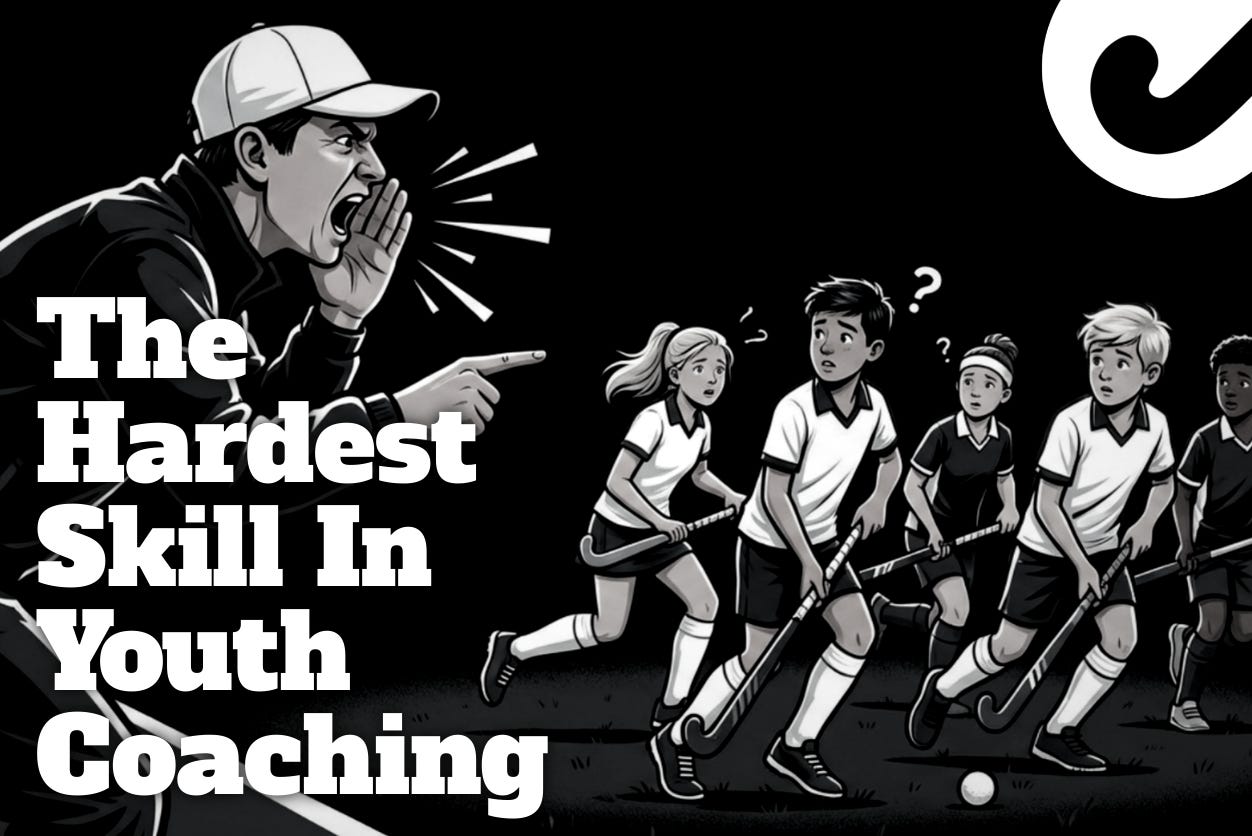
The Hardest Skill in Youth Coaching Field Hockey


Picture this. It’s a U12 training session on a Wednesday evening. There are fifteen kids on the pitch, the ball is moving, and a 3v2 is developing nicely on the left flank. One player is about to make a decision: run with it, or pass inside?
And then the coach explodes.
“PASS IT! PASS IT! LEFT! NO, RIGHT! OKAY STOP. EVERYBODY STOP. Come in. Come in. Right, so what we want to do here is when we have a two versus one on the outside, we need to be thinking about...”
The moment is gone. The decision the kid was about to make? Gone too. The brain that was about to work something out? Switched off. Because there’s no need to think when someone’s already thinking for you.
We’ve all been that coach. More times than we’d like to admit.
TL;DR
Over-coaching is one of the most common problems in youth hockey, and it comes from a good place. Most of us intervene because we care. But constant instruction during play actually slows learning, reduces decision-making capacity, and trains players to wait for answers instead of finding them. The fix isn’t to stop coaching. It’s to design sessions that coach themselves, ask questions instead of giving answers, and learn to tell the difference between a teaching moment and the urge to fill silence.
👉 Why over-coaching happens (and why it’s not your fault)
👉 What the research tells us about constant feedback
👉 Guided discovery: the harder, better approach
👉 Constraints as the coach: sessions that teach themselves
👉 Freezing to teach vs freezing because you can’t help yourself
👉 3 session designs: constraints doing the work
👉 How to know when to stay quiet
👉 3 takeaways
Sources used for these thoughts on youth coaching
Why over-coaching happens (and why it’s not your fault)
There’s a version of the over-coaching story that blames coaches. Bad coaches, controlling coaches, coaches who need to feel important. That’s not the real story.
Most of the coaches I know who over-coach do it because they genuinely want their players to improve. They see the mistake. They know the solution. They can’t bear to watch the opportunity slip by without jumping in. That instinct — to help, to correct, to fix — is exactly the instinct that made them want to coach in the first place.
So yeah. Over-coaching comes from caring. That’s actually what makes it so hard to address.
Here’s the catch, though. Caring doesn’t automatically translate into good coaching. There’s a version of caring that helps players grow, and a version that does the thinking for them. The difference is whether you trust them to work things out, or whether you’re there to provide the answers.
Tin Matkovic, in a masterclass on creativity and player development, put it this way:
That shift, from control to trust, is the whole game.
What the research tells us about constant feedback
Andreu Enrich has spent years studying how coaches actually shape player behaviour. His view on feedback is pretty clear: immediate, specific, and contingent feedback works. Everything else is noise.
What that means in practice is this. Feedback that’s too frequent loses its value. If you say “good!” after every touch, “good” stops meaning anything. Players tune it out. Worse, if every mistake is followed by a correction, players stop risking anything at all. They play safe. They wait for the coach to tell them what to do next. And then, on match day, when no one’s there to shout “PASS IT!”, they freeze.
In Enrich‘s words: “If someone makes a good action and I wait for 30 minutes, you remember that action that was really good... that is of course better than doing nothing. But the value of this positive reinforcement, when it’s taking place just directly after the action takes place, it’s huge.” And the reverse is equally true: positive reinforcement applied constantly, indiscriminately, for everything, is worth nothing at all.
There’s another layer to this. Andreu introduced the Pygmalion Effect in one of our earlier masterclasses: the idea, drawn from psychology and educational research, that coach expectations have a measurable effect on player outcomes. If you coach as if your players can’t think for themselves, they’ll learn not to. If you coach as if they’re capable of working things out, they’ll start to believe that too.
Your behaviour in training is a signal. When you stop the session every thirty seconds to correct, the signal you’re sending is: “You’re not capable of figuring this out without me.” And players, being smart humans, will take you at your word.
Guided discovery: the harder, better approach
So if constant instruction doesn’t work, what does?
Guided discovery is the idea that players learn faster and retain more when they arrive at the answer themselves, rather than receiving it from a coach. Instead of “when there’s a 2v1, pass inside,” you ask: “What did you see when you had the two versus one? What options did you have? What would you do differently?
