

Connections Before Tactics
Why relationships between players matter more than your game plan in field hockey


Connection is more important than tactics
- Adam Commens, high performance director for Hockey Belgium
You can have the most detailed game plan in the world. Press triggers mapped to the second. Set pieces rehearsed until players could run them blindfolded. A structure so well drilled that every position on the pitch has a name, a number, and a responsibility matrix to go with it. And then the whistle blows, the opposition does something you did not expect in the first five minutes, and everything you prepared starts to unravel. Not because the tactics were wrong, but because the players executing them did not truly know each other.
Adam Commens has coached at the highest level of international hockey, including his role as High Performance Director with the Belgian Hockey Federation during the Red Lions’ rise to the top of the world game. When he reflects on what separated the teams that won gold from the ones that fell short, he does not start with formations or pressing patterns. He starts with connection. “Connection is more important than tactics,” Commens says. “Both teams that won gold spent an enormous amount of time learning the why behind each individual.” His top three priorities as a coach? Connection with players first. A culture where innovation flourishes second. Understanding what the world’s best looks like third. Tactics did not even make his top three.
That is a provocative claim, especially for coaches who have invested thousands of hours in video analysis, tactical periodisation, and game modelling. But Commens is not saying tactics do not matter. He is saying that without genuine human connection between the people on the pitch, even the best tactics become fragile. And when connection is strong, tactical execution follows naturally, because players who deeply understand each other make faster decisions, take better risks, and recover from mistakes without the whole system collapsing.
TL;DR
The best tactical plan in the world falls apart when players do not genuinely know and trust each other. This article explores why elite coaches like Adam Commens put relationships before game plans, how connection shows up in small on-pitch moments that win matches, and what you can deliberately do in your training environment to build the kind of trust that makes tactics actually work. With insights from coaches and experts across international hockey, this is a challenge to the assumption that more tactical detail always equals better performance.
Sources
This article draws on insights from the following content on The Hockey Site:
What “Connection” Actually Means at the Elite Level
Let us be honest about what we are not talking about. Connection is not a team dinner. It is not a ropes course. It is not even the barbecue after preseason camp, as enjoyable as that might be. Those things have their place, but they are not what Adam Commens means when he puts connection at the top of his coaching priorities.
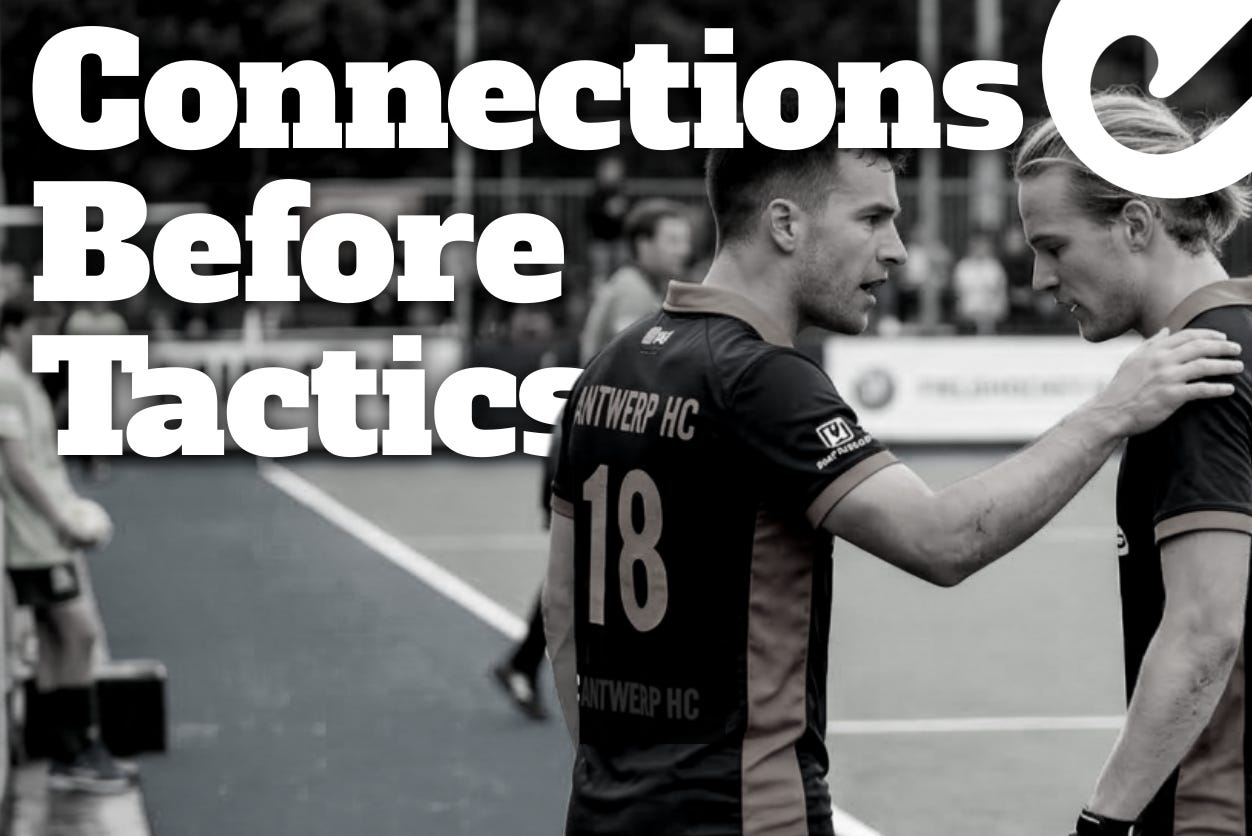
At the elite level, connection means something far more specific. It means that when a midfielder receives the ball under pressure, the forward on the opposite side of the pitch has already started a run, not because a coach drew it on a whiteboard, but because that forward genuinely understands how the midfielder thinks, what that body position means, and what option will be created in the next two seconds. It means a defender covering a space without being asked, because knowing a teammate’s tendencies is so deeply embedded that the response is almost unconscious. It also means a forward sprinting back when needed because he has the back of his teammate, even when his dedicated role is to stay upfront as the target striker.
Commens describes it this way: “You need to really understand each of the individuals that you’re working with and form a connection with them. You don’t have to be best friends, but you need to understand where these athletes come from.” That distinction matters. This is not about forced friendship. It is about genuine understanding. Where does this person come from? What drives them? How do they respond when things go wrong? What do they need from the people around them to perform at their best?
Theo ten Hagen, who has worked with some of the top clubs and national teams in Dutch and Belgian hockey, puts it in behavioural terms. Through his work with personality profiling, he discovered that players on the same team often have fundamentally different preferences for communication, feedback, and stress management. “Some people like to have quite tough feedback,” ten Hagen explains. “And some people have to be a little bit more careful because they have another preference.” The teams that succeed are not the ones where everyone is the same. They are the ones where people know each other, understand and respect those differences.
This is what connection means in practice. Not a vague sense of togetherness, but a precise, working knowledge of the people you share a pitch with.
