

Smarter PCD
Penalty Corner Defence: organising your last line


If there is one moment in field hockey that gives the defence a real chance to prepare, it is the penalty corner. Play stops. The whistle has not yet gone. Everyone knows where the ball will be injected from, how many attackers stand at the top of the circle, and which four bodies will defend the goal. It is, in every sense, the most scripted defensive moment of the match. And yet, scan a gameday in any top league or any U18 game, and you will see PCD units that look like they have never run this scenario together.
That gap, between something that can be rehearsed and something that actually is rehearsed, is where matches get won and lost. Lex Tump’s data from the European Championships showed that only 11% of direct corners were scored in that tournament, and roughly one in five corners convert in the Dutch Hoofdklasse. [1] That is a defensive number. It tells us that even at the very top, with elite flickers like the ones we see in the Olympic Games and World Cup stages on the ball, a well-organised PCD denies them four times out of five. But it also tells us the opposite. The teams that are not well-organised are conceding cheap goals on a moment they had time to prepare for.
So what separates a PCD unit that holds together from one that gives up that fifth goal? Not athleticism. Not the size of the keeper or first runner. It is clarity of role, calm communication before the whistle, and the unit’s ability to read what is coming and adjust without panicking. Let’s get into it.
TL;DR
The penalty corner is the one structured defensive moment a team can fully rehearse, but often teams still look disorganised because nobody has truly defined their roles, the reads, and the talk before the whistle. The data tells us that low flicks dominate, that the first runner is the single biggest defensive variable, and that variations convert at a higher rate than direct shots. This article unpacks what each role actually has to do, when to commit and when to hold, how to organise the call before the whistle blows, and how to train PCD often enough to be sharp without grinding the keeper into the ground. Three training games at the end. Read it before your next defensive corner session.
Sources
This article draws on insights from the following masterclasses and articles on The Hockey Site:
[1] Lex Tump, Inside the Stats of the Penalty Corner
[2] John Goldberg, Developing Elite Drag Flickers: Body Mechanics, Mindset and Practice
[3] Tin Matkovic, Variations on the PC
[4] Penalty Corner Support Roles
[5] Pirmin Blaak, How to train your goalkeeper
What the data is actually telling us
Before we talk about runners and post players, we have to be honest about what a penalty corner produces in the modern game. Lex Tump’s analysis from the Euros and the Hoofdklasse put a hard number on a soft myth. [1] A lot of coaches still quote one in three, a number Tump heard repeated all through his youth coaching, and a number that simply is not in the data. The real rate sits around 11% at international elite level and 17% in the Hoofdklasse for direct attempts, with rebounds the picture barely changes. As a defensive unit, that is the baseline you are already beating before you do anything clever.
What pushes those numbers down further is, more than anything else, the first runner. Tump is direct about it. The first runner has become a specialist position, the equipment has improved enough that bravery is no longer the limiter, and the truly good first runners are not necessarily the fastest people on the pitch. They run hard to the penalty spot, slow down to keep their body and stick under control, and close off one side of the goal. Their job is not to put pressure on the flicker. Their job is to take a corner of the goal away so the keeper only has to defend the other side.
The shot map matters too. Tump’s data shows the vast majority of penalty corner shots go low. The high ones, particularly top right of the goal from a right-handed flicker, score at a disproportionately high rate, but they are rare and used as a surprise. From a defensive priority standpoint that is huge. You do not have to defend the entire goal equally. You build your PCD to deny the high-percentage shot zones and you accept that the very best flickers will occasionally beat you with a perfectly placed top corner, because you cannot have everything.
The last piece of context from the data is the difference between direct and variation. At the Euros, variations were used less often but converted at over 20%, double the rate of direct attempts. [1] In the Hoofdklasse the gap was smaller but still real. What that tells your PCD is that the moment you face a team with a strong flicker, you have to accept that variations are the more dangerous option, and you have to be set up to read them. Stand in a shape that forces the opposition onto their direct flick, then trust your first runner and your keeper to deal with it.
The roles in a PC defence unit
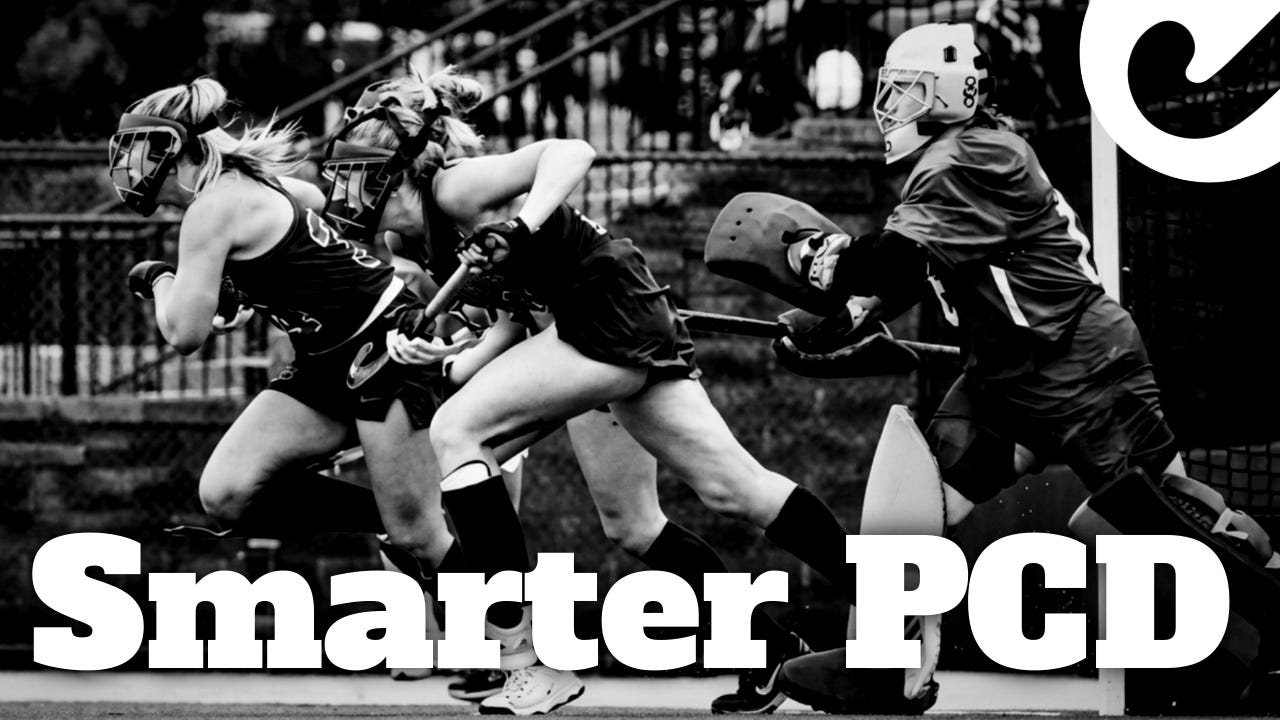
A penalty corner defence has four bodies on the pitch and one in the goal, and every one of them has a different job. The temptation, especially at club level, is to treat PCD as “everyone block the ball”. That is exactly the chaos you see when units have not really sat down and talked about who is doing what.
