The Euro Hockey League never disappoints. Every year, the best club teams in the world come together and remind us what top-level hockey looks like, what it demands, and where the gaps really are. This year was no different. From the opening rounds through to both finals, there were lessons hiding in plain sight for any coach willing to look beyond the scoreboard.
I want to walk through a few of the observations that stood out to me, leaning heavily on insights from Todd Williams, the former Australian international and current Reading head coach, who reviewed the tournament with a defender’s eye and a coach’s curiosity. As he put it himself, “these are observations and insights. By no means am I stating rules. Quite the opposite. One of the great things about coaching are the conversations you have.”
So consider this an invitation to that conversation.
Bridging the Gap: What Watsonians Can Teach Us All
One of the most interesting storylines of the tournament came right at the beginning. Watsonians opened with a convincing 6-1 win over Railway Union, showing excellent circle entries, strong numbers around the ball, and clinical finishing. Then, as they moved up through the bracket and met Gantois, the script flipped. The same patterns they had used to dominate Railway Union were now being used against them.
This is a scenario most of us have faced. Your team can beat teams at a certain level comfortably, but when you step up, the same things happen to you that you just did to someone else. So the question becomes: how do you bridge that gap?
Williams zeroed in on something specific. In several of Watsonians’ attacking opportunities against Gantois, they had genuine numerical overloads, four on two and three on two situations, but failed to convert them into clear-cut chances. The issue was not a lack of opportunity. It was what happened with the opportunity.
“In a four on two, is the type of shot we want to create something where we end up on the outside of the circle, smashing it across and getting it more of a speculative deflection?” Williams asked. “My point is this: if we go back into the play, as we start to recognize that we have four on two, do we actually need to now start looking at an elimination of one of the last two, which is then going to create a much easier shot?”
The takeaway is clear. At the highest level, recognising the overload is not enough. You have to act on it earlier, commit to the elimination further from goal, and trust the interplay to create something more concrete than a speculative cross. Without that recognition and early action, the defenders simply recover, and the moment passes.
The Men’s Final: When Stats Tell One Story and the Game Tells Another
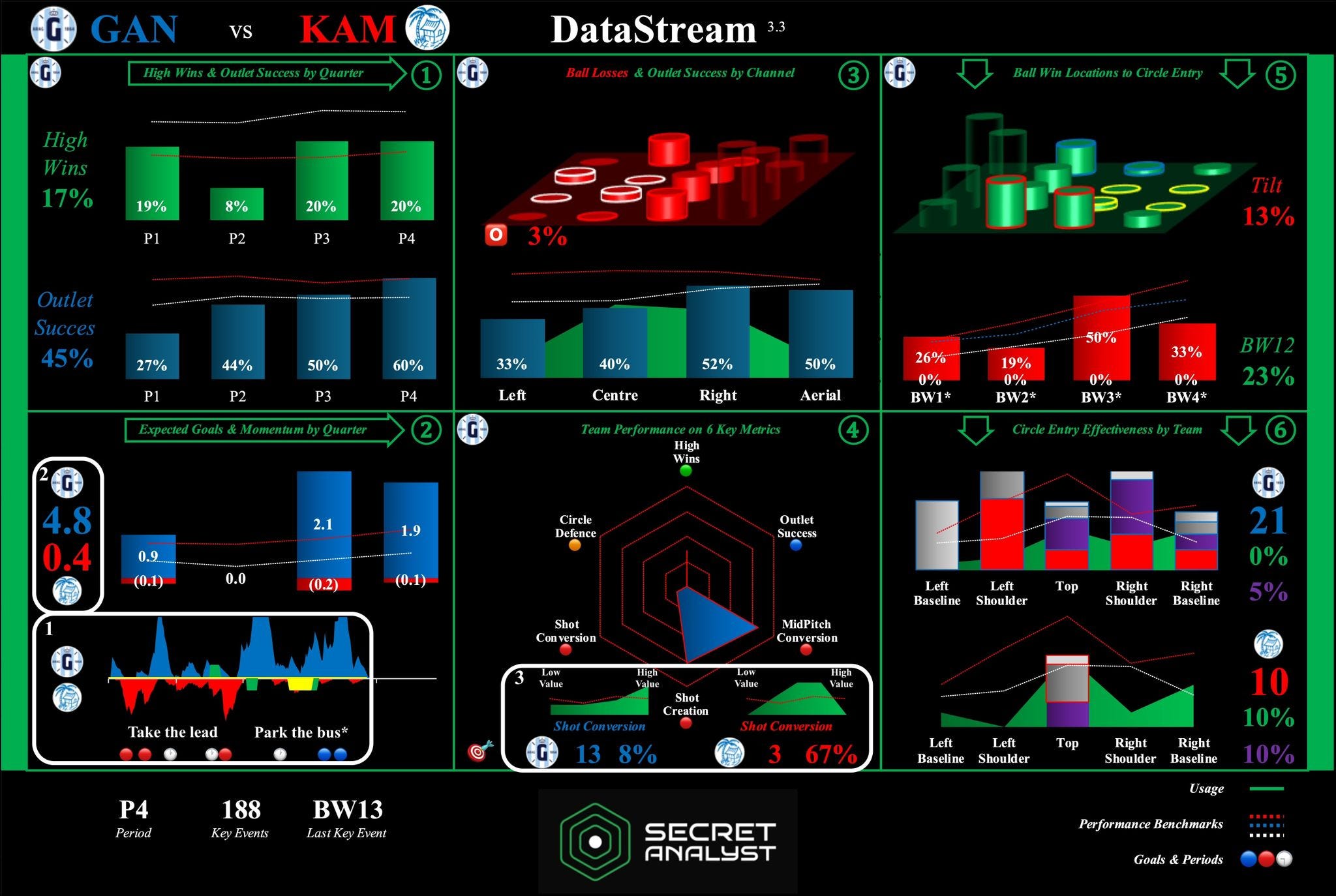
The men’s final between Gantoise and Kampong was a masterclass in why coaches cannot rely on dashboards alone. Thanks to data shared by The Secret Analyst, we could see that Gantoise dominated possession, created 21 circle entries to Kampong’s 10, and generated an expected goals figure of 4.8 compared to Kampong’s 0.4. On paper, that should have been a comfortable Gantoise win.
Kampong won 3-2. Shot conversion: 67%.
Williams made the point perfectly. “You can look at all of this from a coaching and team perspective and go, well, on that data sheet, on that dashboard, it is the game we wanted. On any other day that could look like a comfortable win. So at that point you can say, maybe it’s just bad luck, maybe it wasn’t our day. But that’s where I think, from a coaching perspective, am I going to take that as being the definitive story of the match, or am I going to look in more detail at some video?”
And when you do look at the video, the cracks appear. What Williams identified was a recurring theme in Gantoise’s defensive structure: a lack of cohesion around who should be pressuring the ball carrier, and when.
In several sequences, the nearest defender hesitated while a teammate further away committed. This left passing lanes open and allowed Kampong players, even from limited chances, to find just enough space to finish. And at this level, that is all it takes.
“At this level of hockey, you can’t be giving people uncontested or relatively uncontested passes in,” Williams warned. “What you see at this level is very, very little opportunity needed for people to finish extraordinarily well.”
One goal came from what Williams described as little more than a slight error from Alexander Hendrickx. “The trouble is, he’s giving it to someone of equal quality, Telgenkamp. And that’s as much as a sniff as people at this level need.”
Pressure on the Ball: Decision-Making Over Structure
This became the thread running through the entire review. Whether it was a free hit, an outlet, or a transition moment, the question kept coming back to the same place: who is responsible for putting pressure on the ball, and are they doing it quickly enough?
Williams was careful to point out that this is not about man-to-man versus zonal defending.
“It’s all still about decision making,” he said. “The biggest problem I have is when someone goes, ‘well, yeah, I’m doing my job, I’m where I’m meant to be.’ But actually, if someone’s running in and making a pass into the circle, we need that pressure put on the ball. And that’s about decision making, not structure.”
He even made the slightly provocative observation that teams playing with 10 players can sometimes defend better than with 11. “The great thing about being down to 10 is that it takes the pressures of structure and responsibility away and just says, deal with the danger. And that’s quite often why it’s so very, very difficult to break down a team that’s down a player, because they are using instinct and decision making and scrambling, which is very different to the more organized and structured type of defence.”
For coaches, this is a powerful reminder. Structure gives players a starting point, but the game is won and lost in the micro-decisions that happen when structure is not enough.
Training Overloads and the Counter-Attack Problem
A question from the audience about training these overload situations drew a practical response. Williams pointed out that small-sided games, while valuable, often lack the geography and speed needed to replicate real match scenarios.
“What makes those examples interesting is that the elimination needs to happen earlier. One of them is probably around 40 meters from goal, one about 30 meters. But if you can do that, and that’s where the technical risk is, the defenders get back. So what happens in a small-sided game is that you can’t replicate either the range of the play or the speed of it.”
The implication for training design is significant. If we want our attackers to recognise and exploit overloads on the counter, we need to set up sessions that mirror the distances, speeds, and decision windows of the real thing, not just the principles.
Williams also addressed the issue of depth in counter-attacks. When attackers run level with the ball carrier, defenders are happy to simply sprint back and reset. “Without actually making a pass, nothing’s going to change the defenders from what their current thinking is, just get back, get numbers around it and then see what we can get on it.” The solution? Engage defenders through early passes, force them to commit, and create the two-on-one situations that actually lead to goals.
The Basics Still Win
When asked what a club coach training twice a week should take from the EHL, Williams brought it back to fundamentals.
“You can’t do any of this top end stuff without having the platform of the basics. You’ve got to be able to pass it.”
And then the patience piece.
“Everything takes time. You can’t just say it and expect it to be done. You’re going to have to walk through it. You’re going to have to do it over and over again to develop mind maps of players. And as a coach, you need to be patient with that. Definitely take away the good stuff, but just recognize the length of the road that you’ve got to walk to get there.”
That is perhaps the most honest and important message from the entire review.
Three Takeaways for Your Coaching
1. Recognise overloads earlier and act on them further from goal. Whether it is a four-on-two or a three-on-two, the elimination needs to happen before the defenders recover. Train your players to read the numbers and commit to interplay at 30 to 40 meters out, not just inside the circle.
2. Pressure on the ball is a decision, not a position. Regardless of your defensive structure, someone must take responsibility for closing down the ball carrier. When that does not happen, even the best-organised defence can be undone by a single well-placed pass. Coach your players to prioritise danger over role.
3. Trust the process and invest in the basics. The best teams in the EHL did not get there by copying highlight reels. They got there through relentless repetition of fundamental skills and game understanding. Take the inspiration, but be honest about the road ahead, and be patient enough to walk it.
Some bonus stuff here ↓