

Success 😁 and failure 😩 are both impostors. What matters is how you approach what comes next.
Part 4 in a series of 4 articles based upon the lessons from Coach K 🇺🇸 🏀 and several field hockey 🏑 experts sharing insights about fun, talent, culture and legacy.


There is a moment, somewhere in a long coaching career, when you stop and ask yourself: what am I actually building here? You have been at it for maybe ten, fifteen, twenty years. You have won some things and lost some things. You have developed players who went on to do great things, and you have sat with the quiet satisfaction of knowing you had something to do with that. And then, somewhere in a quiet moment, the bigger questions surface. What happens when I am not here anymore? Am I building something that lasts? And just as importantly: am I looking after myself well enough to keep doing this?
This final article in our series is about exactly that. We are going to look at the “next play” mentality that keeps coaches from being swallowed by either their successes or their failures. We will talk about building leaders inside your team who can carry the culture forward without you having to be in the room. We will get honest about burnout, because it is far more common in our sport than we like to admit. And we will talk about what legacy actually means, because most of the time it has nothing to do with trophies.
The Next Play Mentality
Mike Krzyzewski, aka Coach K, coached basketball for over four decades. He won more games than any other coach in the history of Division One basketball. He coached three Olympic gold medals. He worked with players like Kobe Bryant, LeBron James, and Kevin Durant. And when he reflects on what kept him sharp across all of it, the thing he keeps returning to is something he calls “next play.”
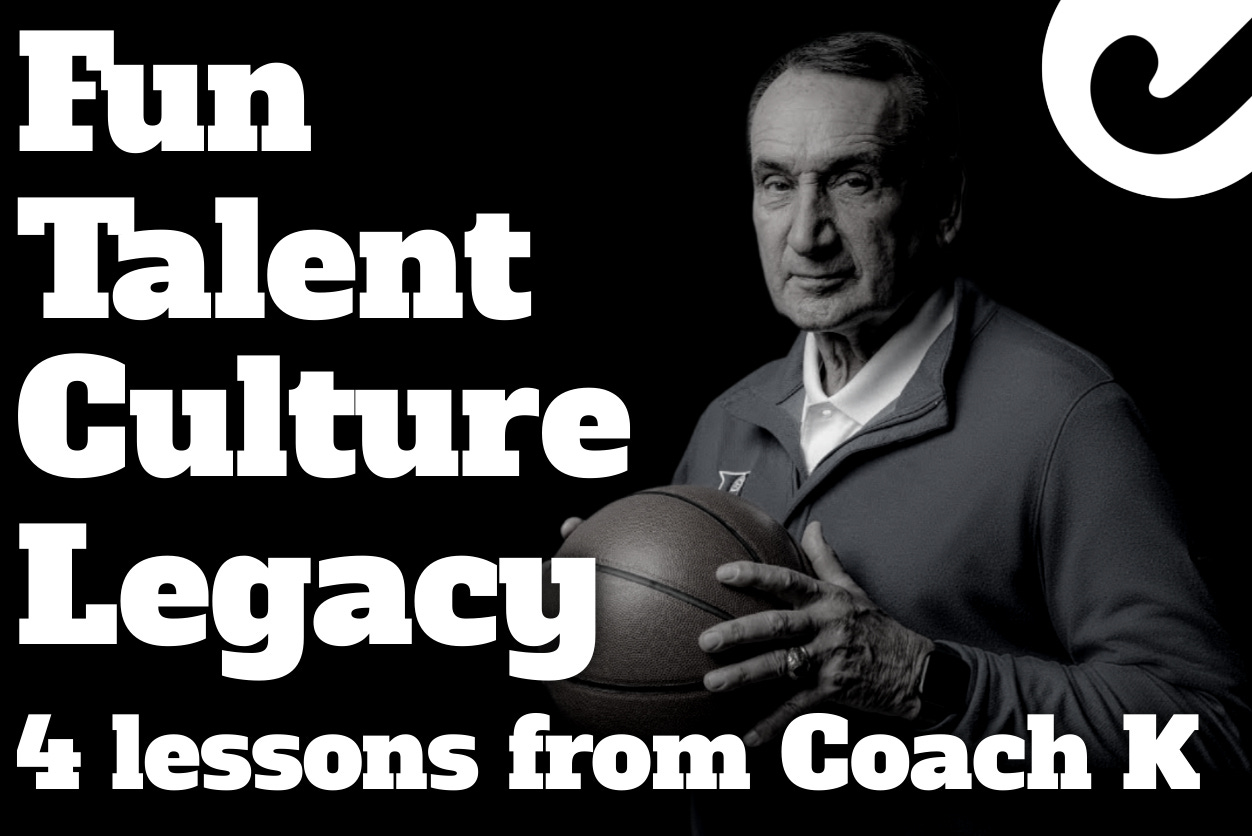
By the way the lessons from Coach K come from his masterclass here.
The idea is simple: after every result, good or bad, you move forward. Not by ignoring what just happened, but by extracting the lesson and committing to what comes next with full attention and full energy. As Coach K puts it, “success and failure are both impostors. What matters is how you approach what comes next.” The players who built long, successful careers at Duke were the ones who embodied this. When they scored, they got back. When they lost the ball, they recovered. When they won a championship, they showed up the following season ready to earn it again.
This maps directly onto something Jamilon Mülders talks about in his masterclass on result versus process. Mülders, who has worked at the highest levels of international hockey 🇩🇪🇨🇳🇳🇱, makes the argument that process-focused coaches are simply more sustainable than results-focused ones. When your self-worth as a coach is too tightly attached to the scoreboard, every loss becomes an identity crisis and every win becomes a pressure to maintain something fragile. When you are anchored in the process, in the quality of the work, in the development you see day to day, you have something to return to regardless of what the result was on gameday.
Mülders goes further than theory. He talks about a specific review cadence, returning to results every two to three weeks to evaluate them as data points rather than verdicts. The question is not “did we win or lose” but “what does this tell us about where we are in the process?” He describes the ideal review as quick, short, and on time. Not a lengthy post-mortem that reopens every wound, but a focused, honest look at what the data shows, followed by a clear decision about what to adjust. That kind of disciplined rhythm is what keeps a coaching team from lurching between elation and despair, and it is what allows you to stay anchored in the work when the results are not yet reflecting it.
Coach K is equally clear about something that often surprises people: handling winning is sometimes harder than handling losing. Staying hungry after a good result, not letting satisfaction become complacency, is one of the great ongoing disciplines of coaching. “
Next play” is not just a response to setbacks. It is a commitment to staying present and moving forward, no matter what just happened.
Building Leaders Who Outlast You
Here is a question worth sitting with: if you disappeared from your programme tomorrow, what would survive?
Not just the tactical system. Not just the results. Would the culture survive? Would the values you have worked to install still be there three seasons later, being taught by the players who were once your juniors to the ones who have just arrived?
Coach K built his programme at Duke around what he calls a tiered leadership structure. Rather than everything running through him, he developed leaders at every level of the team. Senior players were expected not just to perform, but to teach. Shane Battier, one of his great captains, described how he learned what it meant to be a Duke basketball player not from Coach K directly, but from the senior players who were there when he arrived. By the time Battier became a captain himself, he was doing exactly the same thing for the next generation. The culture transferred itself, naturally, because it was real.
Coach K describes this not as delegation but as empowerment. “Give leaders the freedom to lead.” His role was to create the conditions. His players’ role was to inhabit them and then pass them on. The result was a programme that could survive the absence of any individual, including the head coach himself.
Shane McLeod has spoken about this dynamic across two AMA sessions for The Hockey Site, one following the Tokyo Olympics and one after Paris. What stands out across both conversations is how McLeod thinks about the long game. The coaching team did not just prepare for one tournament. They prepared the players to think for themselves, to lead within the group, to carry the programme’s values into situations where no coach was in the room. That kind of preparation does not happen overnight, and it does not happen by accident. It is the result of a coach who is consciously building something bigger than their own tenure.
One thing McLeod is particularly clear about is the distinction between building on strengths and trying to fix weaknesses. Rather than spending energy correcting what players cannot do, his approach leans into what they do exceptionally well — their superpowers. The result is a group where individuals feel genuinely valued for who they are, not constantly reminded of what they lack. That dynamic has a compounding effect on culture. Players who feel seen for their strengths become more invested, more vocal, and more willing to take responsibility. They become the kind of leaders who carry the culture forward without being asked to. The shift McLeod described between Tokyo and Paris was not primarily a tactical one. It was a deepening of exactly this kind of distributed leadership — players equipped not just to execute but to think, adapt, and lead in the spaces where no coach is present.
In practical terms for most of us, this means giving your leaders, often the most experienced players, real responsibility. Not symbolic captaincy, but actual decision-making authority. Let them run sections of training. Let them lead the post-match debrief. Let them set the standards for new arrivals. When you create those structures, two things happen: your players grow into better leaders, and your programme develops a backbone that does not depend entirely on you.
The Single Point of Failure
In the 1994-95 season, Coach K was hospitalised mid-season with serious back problems and emotional exhaustion. He had been running Duke basketball for fifteen years. Seven Final Fours. Two national championships. And then, suddenly, he was gone. The team, without him, collapsed. They had a losing season and lost their culture almost overnight.
When Coach K came back, he analysed what had happened honestly. What he found was not that the players lacked character or that the system was flawed. It was that he had built what he described as a bicycle wheel with all the spokes running through the centre. Every significant decision, every cultural touchstone, every source of energy in the programme ran through him. When he was removed from the equation, the wheel collapsed.
He calls this creating a single point of failure. And it is, he acknowledges, a very easy trap for coaches who care deeply about their work to fall into. You know the team best. You have the vision. You have the energy. So you drive everything. And without fully realising it, you make yourself indispensable in a way that is actually bad for the programme and, as it turned out, bad for you.
This is exactly what the masterclass at The Hockey Site on Why a Coach Needs a Coach addresses. The case is straightforward: coaches, precisely because they are the ones holding everything together, are among the most isolated professionals in sport. You are expected to have answers, to project confidence, to manage everyone else’s emotions while quietly absorbing your own. There is very rarely anyone looking after you the way you look after your players. And over time, that asymmetry catches up with you.
Cody Royle, who comes from the world of Aussie Rules Football and these days a renowned author and consultant on coaching culture, argues that having a coach of your own should not be an occasional intervention but a permanent structural support. Not someone you turn to when things go wrong, but someone who is consistently in your corner, challenging your thinking, and helping you see what you cannot see from inside the role. He also describes a small but powerful practical habit: voice-noting a peer before a difficult conversation. Rather than walking into a hard moment cold, you talk it through out loud first, which forces you to articulate your thinking, hear where it is not yet clear, and arrive better prepared. It sounds simple. Most coaches have never done it.
The cognitive demands of coaching are also worth taking seriously. In the masterclass by Henk Verschuur on The Cognitive Process of Coaching, the sheer mental load of the role is broken down with real clarity. Decision-making, emotional regulation, tactical reading, player management, parent management, federation management: all running simultaneously, all match day, every week. The cognitive load does not diminish as you gain experience. In many ways it grows, because you see more, you know more, and you carry more.
Verschuur makes a point that is particularly worth sitting with: a coach’s internal mental state does not stay internal. It leaks. Anxiety, frustration, and distraction do not just affect your own performance. They seep into the team environment in ways that players absorb before a single word has been spoken. The coach who arrives at training already overwhelmed is, without intending it, adding weight to every interaction. Verschuur’s argument is that curiosity is the antidote. Staying genuinely interested in the problem in front of you, approaching each session and each conversation with deliberate preparation, keeps your mental state open rather than reactive. He also makes a point that is easy to overlook: technical excellence without self-awareness eventually becomes a liability. The coach who knows the game deeply but cannot manage their own internal state will hit a ceiling, because their knowledge will be filtered through a psychology that works against them.
The lesson from Coach K’s crisis is not dramatic. It is practical: build structures around you that can function without you, find people who challenge your thinking and support your wellbeing, and do not wait until your body stops you before you take the question of self-care seriously.
Taking Care of Yourself Is Not Optional
The culture of coaching, also in field hockey, still carries a certain pride in endurance. The early starts, the late evenings, the weekends given over to fixtures and video review. There is something in the coaching identity that equates sacrifice with commitment, and rest with something close to weakness. Coach K spent most of his career operating by a version of that logic. And then, at the top of his profession, he was forced to stop.
What he said afterwards is worth sitting with. “I let my team down.” Not because he lost games, but because he had not looked after himself well enough to stay present for them. There is a second lesson from his career that cuts even deeper. In the final home game of his career, his last regular season match against North Carolina, he let the emotion of the occasion overwhelm his preparation. Duke lost. And his immediate internal response, which he later called out in himself sharply, was to feel that the team had let him down. “Which was so bad,” he says. He had started thinking like a player, not a coach. He had made the moment about himself.
These two failures, the physical collapse that came from running too hard for too long, and the emotional failure that came from losing his coaching identity for one high-stakes moment, are not failures of a bad coach. They are the very human failures of someone who cared enormously and forgot, briefly, to look after the thing that made the caring sustainable: himself.
Coach K is clear that vulnerability is not weakness. He talks about learning this, partly through his wife and daughters, in a world where his entire upbringing had treated male emotion as something to suppress.
“Through emotion, you reach a deeper level of commitment and relationship, as long as you use emotion to build and grow, not to destroy.” Saying “I don’t know” and asking for help is a skill. For many coaches, it is the hardest one to develop.
What does looking after yourself actually look like in practice? It looks like having people in your life outside of hockey who you talk to honestly. It looks like having a mentor or coach of your own who can see the patterns you cannot see from the inside. Which is precisely the permanent support structure Cody Royle describes, not a crisis intervention but an ongoing relationship that keeps you sharp and honest across the long arc of a career. It looks like building the kind of self-awareness that Henk Verschuur identifies as essential: knowing your own mental state clearly enough to stop it from leaking into your environment in ways that harm the people around you. It looks like protecting some version of a life outside the sport, something Coach K did consistently by investing deeply in his family even through the most intense seasons of his career. And it looks like treating your own development as a coach with the same seriousness that you treat your players’ development.
Legacy Is Not a Trophy
Raoul Ehren, current head coach for the Dutch women, has been involved in elite hockey for longer than most of us can remember. Across the very best in the top domestic league (the Dutch Hoofdklasse), multiple national programmes and many years at the sharp end of high-performance coaching, his AMA session on The Hockey Site returns again and again to a theme that gets to the heart of what we are talking about here: sustainability. Not just of a team’s performance, but of a coach’s ability to keep growing and contributing across a long career.
What strikes me about coaches who sustain excellence across decades is not that they found a system and stuck to it. It is that they kept asking questions. They stayed curious. They kept finding new things to learn from. And they stayed connected to the thing that brought them to coaching in the first place: a genuine love for what happens when a group of people commit to getting better together.
Ehren’s approach to sustaining a programme is notable for its directness. He moves quickly. When he identifies what needs to change, he acts on it — not recklessly, but without the paralysis that afflicts coaches who overthink every decision. He talks about leveraging superpowers: understanding what your programme does better than anyone else and building around that, rather than trying to compete on every front simultaneously. And he speaks about continuous analysis not as a burden but as a habit of mind — a standing curiosity about where things stand and what the next move should be. The practical results of this approach speak for themselves: taking a national programme (the Belgian women) from twelfth in the world to third inside four years is not an accident. It is what happens when a coach combines strategic clarity, fast and decisive action, and a relentless focus on the things that actually move the needle.
Coach K’s mother gave him a piece of advice when he was fourteen years old, the night before he started high school. “Make sure you get on the right bus.” By which she meant: choose your people carefully. Only travel with good people, and only follow someone who is worth following. Looking back across a fifty-year career, he says that simple idea shaped almost everything. The people on his bus, his staff, his players, his family, determined what was possible. No one accomplishes what they want alone.
Legacy, when we strip away the trophies and the records, comes down to this: the people you helped become better versions of themselves.
The player who is now a coach passing on something they learned from you. The captain who learned how to lead in your programme and is now leading in their workplace, their family, their community. The culture you built that outlasted your tenure because you built it to be real, not to be dependent on your presence.
Coach K says it simply: “You can’t stay the same. You gotta keep getting better.” Not as a pressure. As an invitation. The game keeps evolving. The players keep changing. The demands on coaches keep growing. And the coaches who last, who build something that genuinely lasts, are the ones who approach that reality with curiosity rather than resistance.
What We Covered: The Recap
This series started with fun. Without it, nothing else sticks. We then looked at talent, and how the best coaches see more in their players than the players see in themselves. We explored culture, and how a truly healthy team environment is built not just on wins but on shared values and the courage to protect them.
And now, in this final piece, we have come around to the long game.
The next play mentality keeps you moving forward without being dragged down by either success or setbacks. Building leaders inside your team, people who can carry the culture forward without you, is one of the most important things you can do for your programme. Protecting yourself from becoming a single point of failure is not selfishness; it is good programme design and basic self-respect. And looking after yourself, really looking after yourself, is what makes a long career possible. Legacy is not what you won. It is who you built and what you left behind in them.
So: what bus are you on? Who is on it with you? And are you looking after yourself well enough to still be driving it, with full energy and genuine enthusiasm, ten years from now?
Those are the questions worth sitting with. And they are worth coming back to, regularly, throughout a coaching career that is worth having.